Category: Motorcycle Accident Guides

  • Motorcycle Accident Settlement Offers: A Careful Checklist Before Signing a Release

    Motorcycle Accident Settlement Offers: A Careful Checklist Before Signing a Release

    MOTORCYCLE & INJURY LAW / RESOURCES

    Motorcycle Accident Settlement Offers: A Careful Checklist Before Signing a Release

    Motorcycle Accident Settlement Offers: A Careful Checklist Before Signing a Release: a practical guide for riders and families.

    Practical legal informationOctober 28, 2026
    ← All Rider Law articles10 min read · October 2026

    A settlement offer may arrive while medical appointments, repair discussions or insurance questions are still underway. Receiving an offer does not establish that it fairly reflects the claim, and rejecting one does not guarantee a better result later. The key is to understand what the proposed payment covers, which parties are being released, which facts remain unresolved and whether deadlines still require action. This guide offers a practical document checklist for evaluating the proposal with appropriate legal advice.

    Important: This guide is educational. In an emergency, follow medical and public-safety directions. Legal rights and coverage depend on the full evidence, policy documents, jurisdiction and timing.

    Identify precisely which claim the offer covers

    An insurance communication may concern vehicle repairs, bodily injury, a particular insured person or several claims together. Describe the observed event before explaining what you think caused it. Where available, identify the source, date and person involved. A reliable chronology is more valuable than an emphatic conclusion that overlooks the surrounding evidence.

    Read the offer letter and accompanying release, noting the covered event, parties, dates and claims. Evidence is most useful when a reader can reconstruct when it was created and what it actually depicts. Save original photographs and recordings separately from annotated presentation copies. If a detail is uncertain, say so rather than attempting to make the sequence appear cleaner than the available evidence supports.

    A property-damage payment can appear separate from a bodily-injury proposal, but the release wording must be checked. Ask which source supports this part of the timeline and what might explain the same event differently. A careful record should preserve the original material and identify uncertainty rather than hiding it.

    Do not assume a familiar-looking form always releases only the item mentioned in the covering email. Before taking a difficult-to-reverse action, review the relevant record and consult an appropriate professional. Document who will follow up, what information is missing and whether a legal or insurance deadline may require prompt attention.

    Compare the offer with known records

    A useful assessment separates verified costs, disputed amounts and uncertain future issues. Separate records that document an event from interpretations of legal responsibility. A photograph, witness statement or policy letter may support one part of the account without proving everything. That distinction makes case review more precise.

    Reconcile treatment invoices, insurer payments, wage documents, property estimates and out-of-pocket records. Health and immediate safety are not interchangeable with legal strategy. Clinicians and emergency responders address medical concerns, and qualified legal counsel can assess possible claims, deadlines and evidence needs. Keep those roles distinct even when a serious collision makes many decisions feel urgent.

    A hospital statement may still be pending insurance adjustment when the offer is made.

    Do not rely on a rough total that double-counts charges and payments.

    Review the injury timeline without guessing

    Treatment status, clinician advice and documented limitations may affect the information available for evaluation. Focus on what could be verified. Is there an original recording, a dated report, a clinical record or a financial statement? If the answer is no, identify the missing material and consider whether it can be lawfully requested.

    Organize appointments, records, recommendations, work restrictions and current questions for professionals. Insurance communications can contain policy numbers, adjuster references, estimates and requests for information. Maintain a dated communication log and retain the original letters, forms and attachments. That record can help a reviewer find exactly what was requested and when.

    A rider may still be awaiting a specialist interpretation when a release is offered.

    Do not predict medical recovery from an internet checklist or alter clinical decisions for settlement strategy.
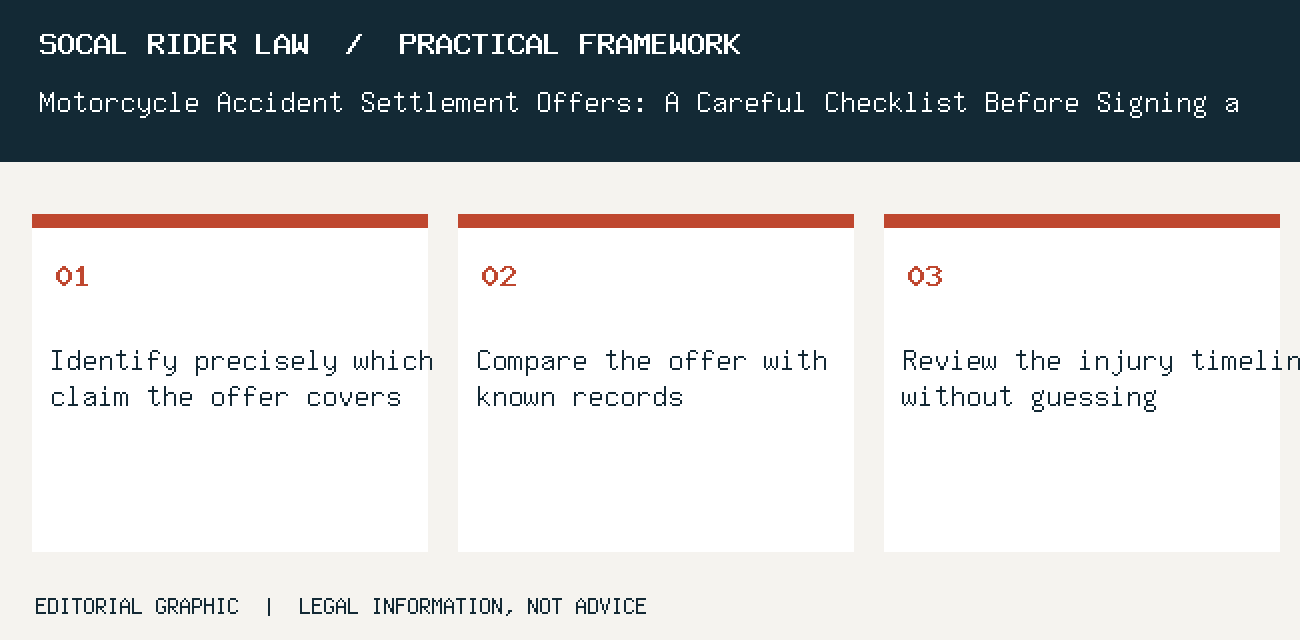
    Identify precisely which claim the offer covers; Compare the offer with known records; Review the injury timeline without guessing
    Illustrated guide: Compare the offer with known records

    Consider disputed fault evidence

    An insurer may discount an offer based on a version of the crash that is not yet fully supported. Keep decisions proportionate to the information available. Some matters require immediate attention, but a final release, formal allegation or other irreversible action deserves case-specific review. Preserve uncertainties rather than presenting them as settled facts.

    Identify scene photos, original video, witnesses, incident reports and factual disagreements. The scene may change quickly as vehicles are removed, traffic resumes and weather shifts. Reliable photographs and notes can preserve context, but they should not put anyone in danger. Describe the source of every image and avoid assigning a conclusion the image alone cannot establish.

    A driver and rider may give conflicting accounts of an intersection light sequence.

    Do not accept or reject a fault percentage without understanding its factual basis.

    Check all possible insurance sources

    The final financial picture may depend on other policies, available limits and coverage conditions.

    Collect declarations, claim correspondence and the operative insurance policy language. Often the facts that matter most are not the ones initially debated. A disputed speed estimate, camera clock or lane position may later be clarified by an independent record. Maintain competing versions when they exist and identify what additional information could help evaluate them.

    A third-party offer may interact with underinsured motorist questions under another policy.

    Do not assume that the largest available policy limit is the same as the value of a claim.

    Understand fees, expenses and reimbursement

    The gross settlement figure may differ from funds available after applicable obligations are resolved. That distinction makes case review more precise.

    Request a transparent explanation of proposed fees, expenses and any claimed medical or benefit reimbursements. Documentation of costs should separate amounts billed, amounts paid, estimated future costs and balances in dispute. Attach the underlying invoice or statement to the summary. Accuracy matters more than inflating the size of the file with unverified totals.

    A large written offer may need to account for outstanding provider balances and contractual repayment terms.

    Do not assume every lien or reimbursement demand has already been verified.
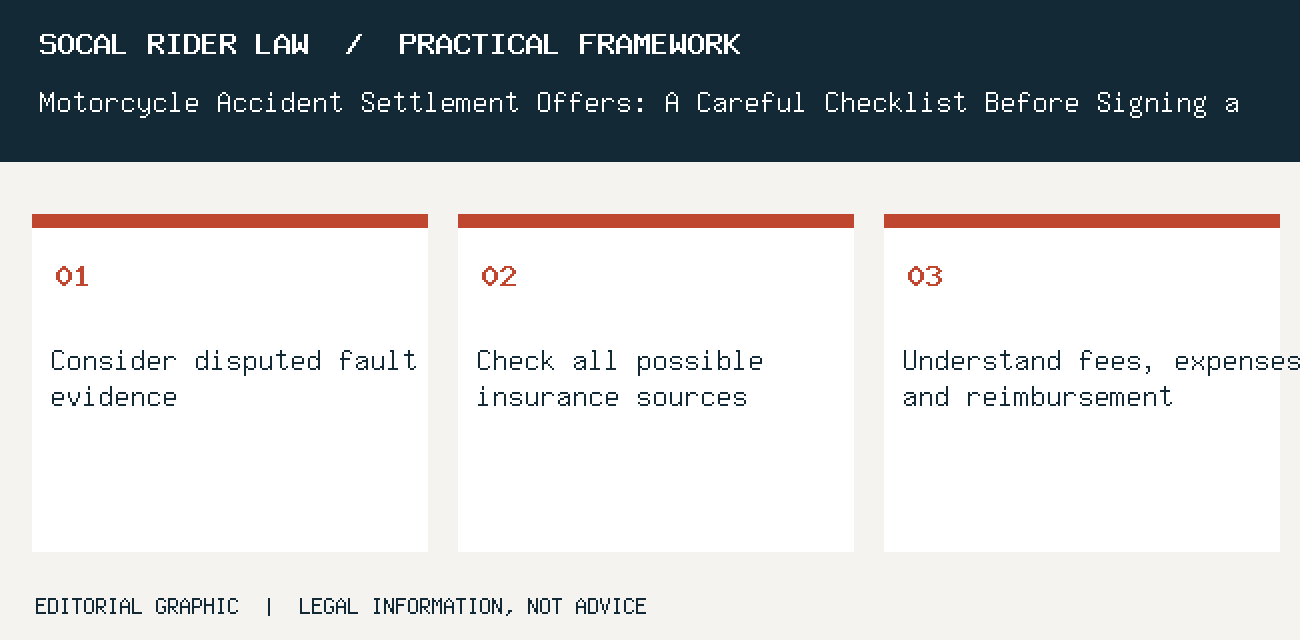
    Consider disputed fault evidence; Check all possible insurance sources; Understand fees, expenses and reimbursement
    Illustrated guide: Check all possible insurance sources

    Read confidentiality and non-admission language

    Settlement documents can include confidentiality, non-disparagement, cooperation or other continuing provisions. Focus on what could be verified.

    Mark every obligation and ask how it would operate after payment. An independent observer may have seen only part of the event. Preserve contact information and the witness’s own account without pressuring the person toward a preferred statement. A report from one angle can be important yet incomplete.

    A release might cover unknown claims or related parties beyond the obvious insurer.

    Do not sign merely because the payment amount appears in bold on the first page.

    Clarify the payment and closing process

    A settlement agreement should address signatories, timing, payment delivery and completion requirements. Keep decisions proportionate to the information available.

    Identify who signs, when funds are due, how releases are exchanged and what happens if an obligation is missed. California roadway rules and insurance requirements provide context, not an automatic outcome for a specific accident. A rider’s conduct, another driver’s actions, the physical scene and applicable defenses all require review. Avoid generic statements that any single rule decides fault.

    A claimant may need confirmation that a release is received before an insurer issues payment.

    Do not treat an unsigned draft as a completed transaction.

    Evaluate alternatives and deadlines

    A settlement decision weighs uncertainty, cost, evidence, practical needs and the risks of continued dispute.

    Discuss options and any applicable filing or policy deadlines with qualified counsel promptly. A useful consultation packet should be concise enough to navigate but complete enough to reveal uncertainties. Include a timeline, source index, key communications, major bills or estimates and an unanswered-question list. Early, organized review can identify next steps without promising recovery.

    Negotiation may continue, but that does not necessarily suspend an independent legal deadline.

    Do not wait for a response to an offer if another deadline requires action.
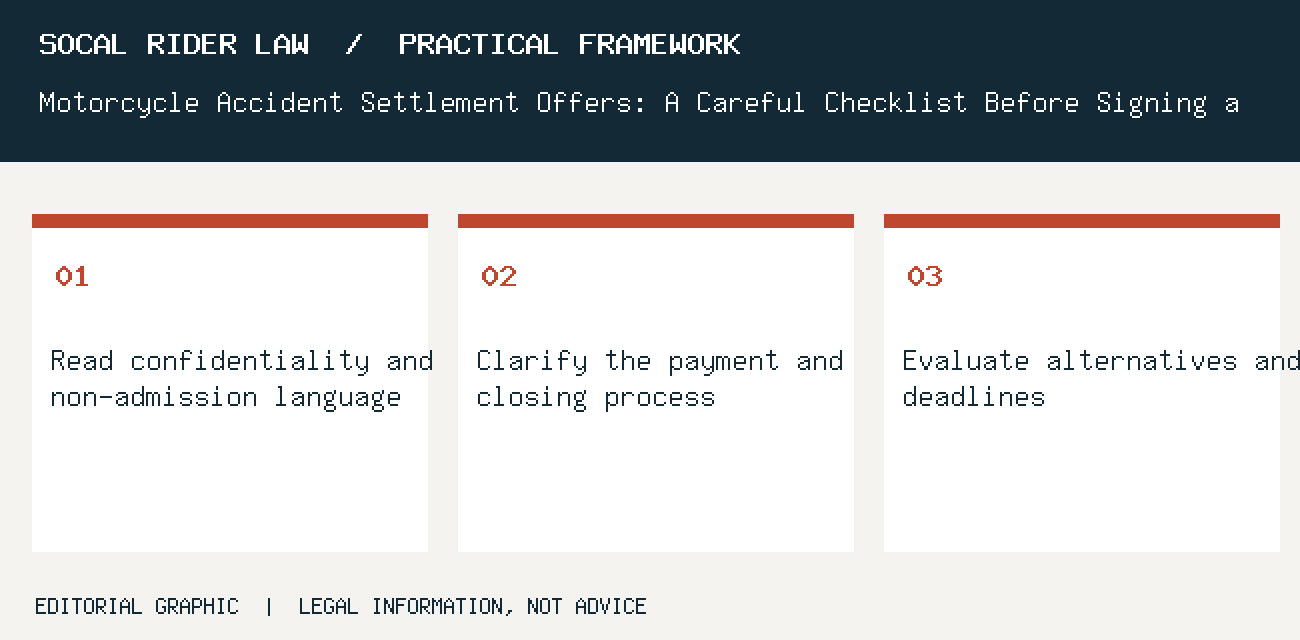
    Read confidentiality and non-admission language; Clarify the payment and closing process; Evaluate alternatives and deadlines
    Illustrated guide: Clarify the payment and closing process

    Practical nine-point checklist

    1. Identify precisely which claim the offer covers: Read the offer letter and accompanying release, noting the covered event, parties, dates and claims.
    2. Compare the offer with known records: Reconcile treatment invoices, insurer payments, wage documents, property estimates and out-of-pocket records.
    3. Review the injury timeline without guessing: Organize appointments, records, recommendations, work restrictions and current questions for professionals.
    4. Consider disputed fault evidence: Identify scene photos, original video, witnesses, incident reports and factual disagreements.
    5. Check all possible insurance sources: Collect declarations, claim correspondence and the operative insurance policy language.
    6. Understand fees, expenses and reimbursement: Request a transparent explanation of proposed fees, expenses and any claimed medical or benefit reimbursements.
    7. Read confidentiality and non-admission language: Mark every obligation and ask how it would operate after payment.
    8. Clarify the payment and closing process: Identify who signs, when funds are due, how releases are exchanged and what happens if an obligation is missed.
    9. Evaluate alternatives and deadlines: Discuss options and any applicable filing or policy deadlines with qualified counsel promptly.

    Two professionals reviewing documents together during a consultation
    Illustrative motorcycle and injury-related photograph from the SoCal Rider Law media library.

    Frequently asked questions

    Must I accept the insurer’s first offer?

    No general rule requires accepting the first offer; circumstances and deadlines need review. The specific facts and official documents should be evaluated before any legal or coverage conclusion.

    Can I settle just property damage?

    Sometimes distinct claims can be handled separately, but the actual release language is decisive.

    Does an insurer’s stated percentage of fault settle the legal issue?

    No. It is a position that should be evaluated against the facts and governing law.

    What if I sign and later discover new expenses?

    A broad release may have significant consequences. Review its scope before signing.

    Official resource: California Courts: civil lawsuit deadlines.

    General information, not legal or medical advice. No attorney-client relationship is created by reading this page, and no outcome is guaranteed. Timelines and remedies depend on specific facts and law.

    Questions after a motorcycle crash?

    Coverage, treatment and responsibility can be complicated. Request a case review based on your actual accident, insurance documents and concerns.

    Request case review

  • Motorcycle Accident Medical Bills: Organizing Treatment, Expenses, and Insurance Records

    Motorcycle Accident Medical Bills: Organizing Treatment, Expenses, and Insurance Records

    MOTORCYCLE & INJURY LAW / RESOURCES

    Motorcycle Accident Medical Bills: Organizing Treatment, Expenses, and Insurance Records

    Motorcycle Accident Medical Bills: Organizing Treatment, Expenses, and Insurance Records: a practical guide for riders and families.

    Practical legal informationOctober 28, 2026
    ← All Rider Law articles9 min read · October 2026

    After a serious motorcycle accident, bills and clinical documents may arrive at different times and from different providers. A hospital statement, physical-therapy invoice, insurer explanation of benefits and pharmacy receipt can all relate to one course of care without showing the same balance. Keeping these records organized helps riders understand what information is available and what remains unclear. This article is about documentation and communication; healthcare decisions should remain with qualified medical professionals.

    Important: This guide is educational. In an emergency, follow medical and public-safety directions. Legal rights and coverage depend on the full evidence, policy documents, jurisdiction and timing.

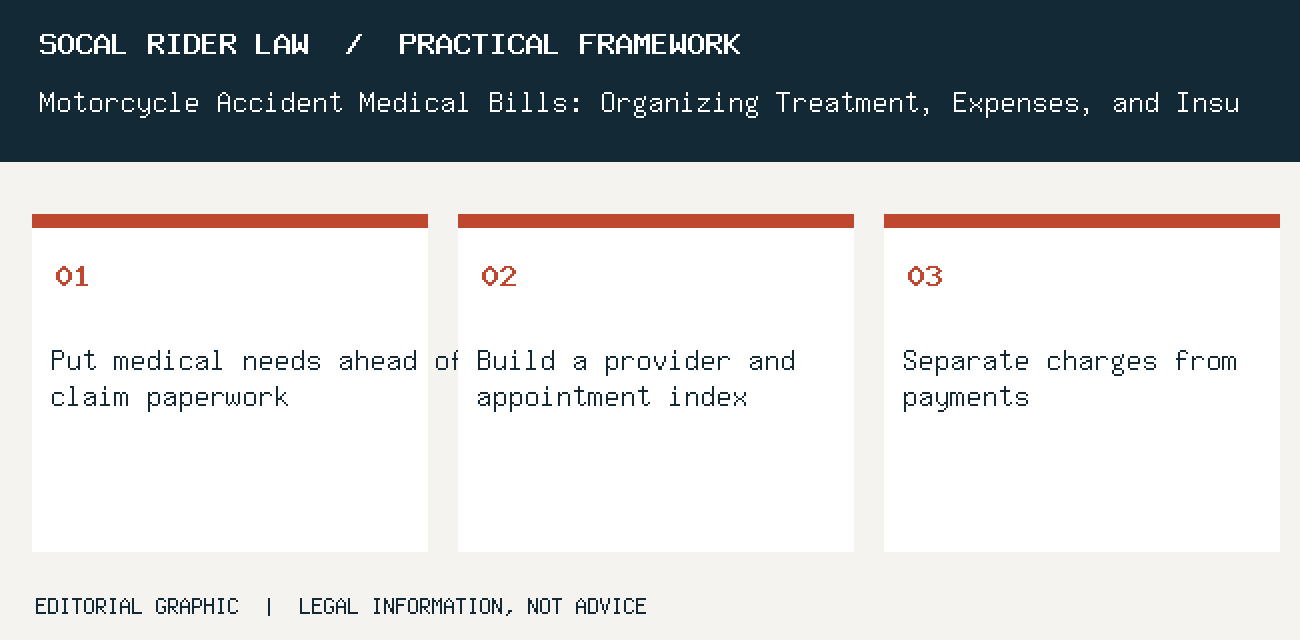
    Put medical needs ahead of claim paperwork

    Motorcycle injuries can require emergency assessment, monitoring, therapy or follow-up with specialists. Describe the observed event before explaining what you think caused it. Where available, identify the source, date and person involved. A reliable chronology is more valuable than an emphatic conclusion that overlooks the surrounding evidence.

    Follow clinicians’ advice, seek appropriate care and retain discharge instructions for later reference. Evidence is most useful when a reader can reconstruct when it was created and what it actually depicts. Save original photographs and recordings separately from annotated presentation copies. If a detail is uncertain, say so rather than attempting to make the sequence appear cleaner than the available evidence supports.

    A rider may receive referrals that are not reflected in the initial emergency bill. Ask which source supports this part of the timeline and what might explain the same event differently. A careful record should preserve the original material and identify uncertainty rather than hiding it.

    Do not delay indicated treatment merely to create a simpler insurance narrative. Before taking a difficult-to-reverse action, review the relevant record and consult an appropriate professional. Document who will follow up, what information is missing and whether a legal or insurance deadline may require prompt attention.

    Build a provider and appointment index

    Multiple facilities may issue separate records for the same date, including hospital, imaging and professional services. Separate records that document an event from interpretations of legal responsibility. A photograph, witness statement or policy letter may support one part of the account without proving everything. That distinction makes case review more precise.

    Track dates, provider names, visit purposes, report locations and follow-up instructions. Health and immediate safety are not interchangeable with legal strategy. Clinicians and emergency responders address medical concerns, and qualified legal counsel can assess possible claims, deadlines and evidence needs. Keep those roles distinct even when a serious collision makes many decisions feel urgent.

    An emergency department visit may generate separate physician and imaging statements.

    Do not assume several bills on one date prove duplicate billing.

    Separate charges from payments

    The amount billed by a provider is not always the amount paid by insurance or the current patient balance. Focus on what could be verified. Is there an original recording, a dated report, a clinical record or a financial statement? If the answer is no, identify the missing material and consider whether it can be lawfully requested.

    Record the billed amount, adjustments, paid amount, pending insurance and remaining balance per account. Insurance communications can contain policy numbers, adjuster references, estimates and requests for information. Maintain a dated communication log and retain the original letters, forms and attachments. That record can help a reviewer find exactly what was requested and when.

    A statement sent before insurance adjudication may later be revised substantially.

    Do not present a preliminary invoice amount as the final cost without explanation.

    Put medical needs ahead of claim paperwork; Build a provider and appointment index; Separate charges from payments
    Illustrated guide: Build a provider and appointment index

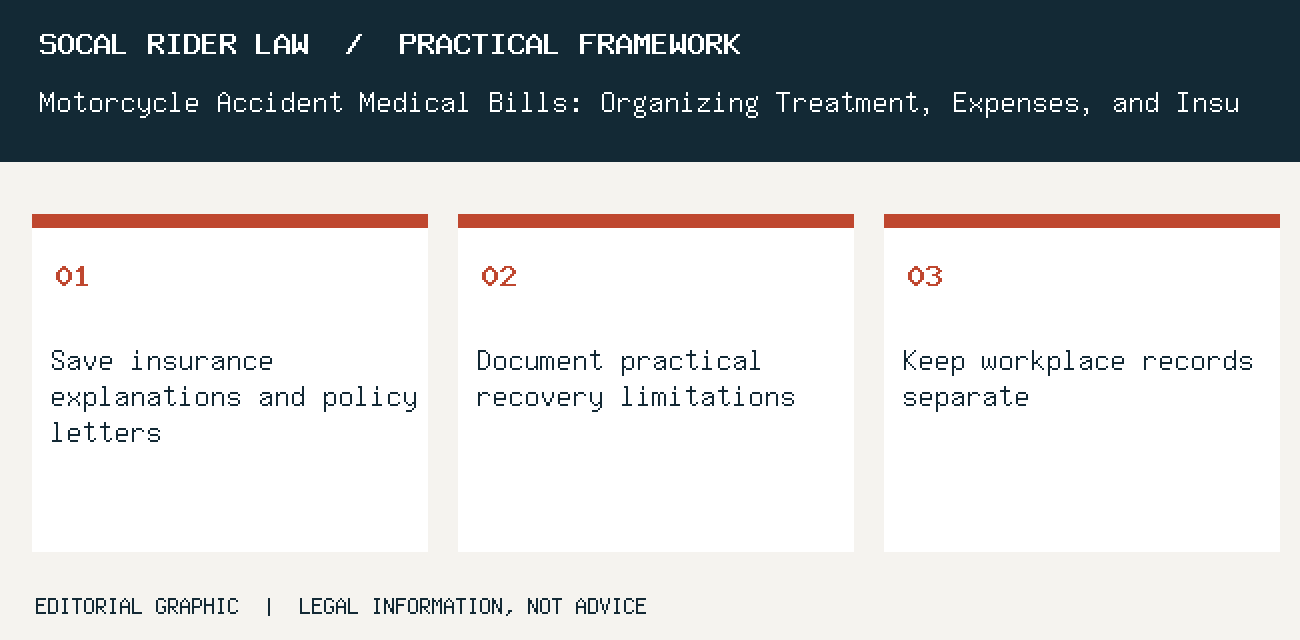
    Save insurance explanations and policy letters

    Explanations of benefits, reimbursement notices and coverage decisions can clarify how a charge was handled. Keep decisions proportionate to the information available. Some matters require immediate attention, but a final release, formal allegation or other irreversible action deserves case-specific review. Preserve uncertainties rather than presenting them as settled facts.

    Keep letters and explanations with corresponding provider bills and account identifiers. The scene may change quickly as vehicles are removed, traffic resumes and weather shifts. Reliable photographs and notes can preserve context, but they should not put anyone in danger. Describe the source of every image and avoid assigning a conclusion the image alone cannot establish.

    A rejected item may be a coding issue, a coverage dispute or a request for additional documentation.

    Do not guess why a carrier denied or reduced a bill without checking the actual reason.

    Document practical recovery limitations

    Injuries may affect movement, work, transportation and household routines in ways not captured by a billing statement.

    Maintain modest, dated notes alongside clinician instructions and any work restrictions. Often the facts that matter most are not the ones initially debated. A disputed speed estimate, camera clock or lane position may later be clarified by an independent record. Maintain competing versions when they exist and identify what additional information could help evaluate them.

    A person may need rides to physical therapy or temporary changes in work duties.

    Do not exaggerate symptoms or disregard professional treatment guidance for purposes of a claim.

    Keep workplace records separate

    Wage-related claims require documentation of actual earnings, time off or reduced responsibilities. That distinction makes case review more precise.

    Preserve pay records, schedules, leave notices and employer communications where appropriate. Documentation of costs should separate amounts billed, amounts paid, estimated future costs and balances in dispute. Attach the underlying invoice or statement to the summary. Accuracy matters more than inflating the size of the file with unverified totals.

    A rider may lose a scheduled shift while continuing to receive some paid leave benefits.

    Do not treat every day away from normal routines as an identical wage loss.

    Save insurance explanations and policy letters; Document practical recovery limitations; Keep workplace records separate
    Illustrated guide: Document practical recovery limitations

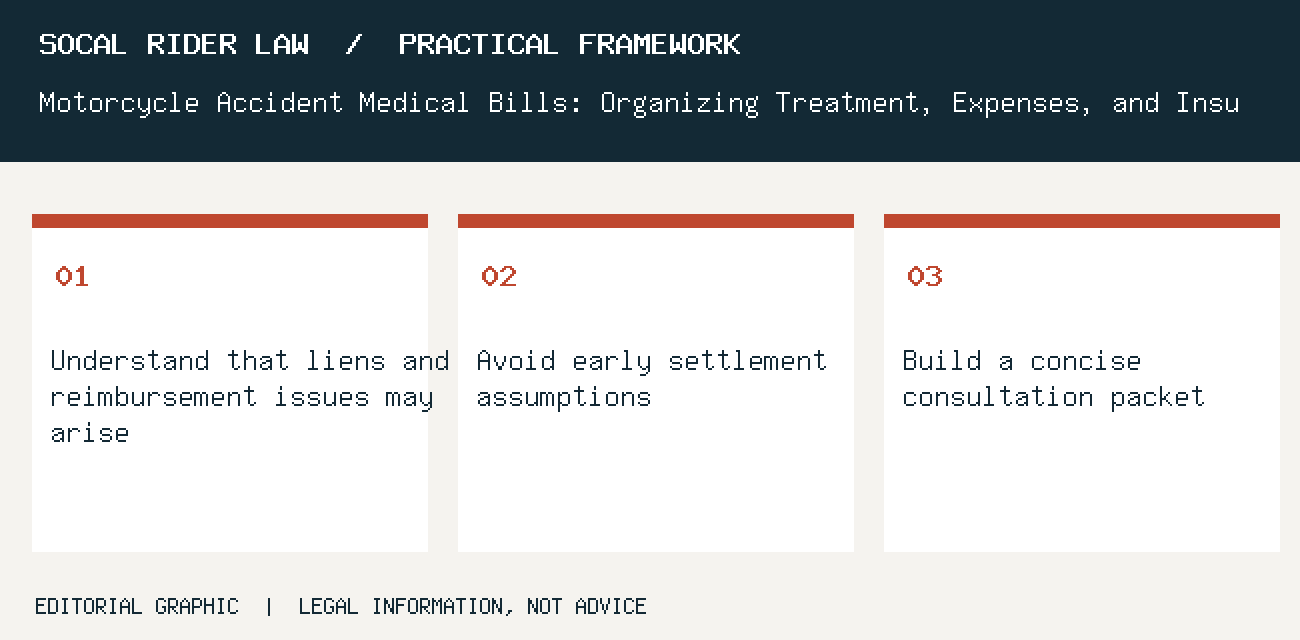
    Understand that liens and reimbursement issues may arise

    Depending on benefits and agreements, some entities may assert reimbursement or payment rights from a settlement. Focus on what could be verified.

    Save related letters, coverage documents, benefit statements and payment history for professional review. An independent observer may have seen only part of the event. Preserve contact information and the witness’s own account without pressuring the person toward a preferred statement. A report from one angle can be important yet incomplete.

    A medical provider or health benefit plan may communicate a claimed balance after initial treatment.

    Do not promise that every claimed reimbursement is valid or invalid without examining the underlying rules.

    Avoid early settlement assumptions

    The treatment course, documented expenses, liability evidence and insurance coverage may remain uncertain. Keep decisions proportionate to the information available.

    Keep offers, release documents and requests for records together with the current treatment timeline. California roadway rules and insurance requirements provide context, not an automatic outcome for a specific accident. A rider’s conduct, another driver’s actions, the physical scene and applicable defenses all require review. Avoid generic statements that any single rule decides fault.

    A proposed payment may arrive before later specialist appointments or final account adjustments.

    Do not sign a broad release without understanding its scope and possible consequences.

    Build a concise consultation packet

    A legal review benefits from a factual chronology and a reconciled document index rather than a box of unsorted invoices.

    Prepare visit dates, providers, invoices, insurer payments, work records, incident details and questions. A useful consultation packet should be concise enough to navigate but complete enough to reveal uncertainties. Include a timeline, source index, key communications, major bills or estimates and an unanswered-question list. Early, organized review can identify next steps without promising recovery.

    The attorney can identify which records or policies need closer analysis without making medical decisions.

    Do not assume an organized file guarantees a particular recovery.

    Understand that liens and reimbursement issues may arise; Avoid early settlement assumptions; Build a concise consultation packet
    Illustrated guide: Avoid early settlement assumptions

    Practical nine-point checklist

    1. Put medical needs ahead of claim paperwork: Follow clinicians’ advice, seek appropriate care and retain discharge instructions for later reference.
    2. Build a provider and appointment index: Track dates, provider names, visit purposes, report locations and follow-up instructions.
    3. Separate charges from payments: Record the billed amount, adjustments, paid amount, pending insurance and remaining balance per account.
    4. Save insurance explanations and policy letters: Keep letters and explanations with corresponding provider bills and account identifiers.
    5. Document practical recovery limitations: Maintain modest, dated notes alongside clinician instructions and any work restrictions.
    6. Keep workplace records separate: Preserve pay records, schedules, leave notices and employer communications where appropriate.
    7. Understand that liens and reimbursement issues may arise: Save related letters, coverage documents, benefit statements and payment history for professional review.
    8. Avoid early settlement assumptions: Keep offers, release documents and requests for records together with the current treatment timeline.
    9. Build a concise consultation packet: Prepare visit dates, providers, invoices, insurer payments, work records, incident details and questions.
    Medical professional reviewing hospital records and treatment information
    Illustrative motorcycle and injury-related photograph from the SoCal Rider Law media library.

    Frequently asked questions

    Does every medical bill count as recoverable damages?

    Not automatically. The facts, necessity, proof, payments and applicable law can affect evaluation. The specific facts and official documents should be evaluated before any legal or coverage conclusion.

    What is an explanation of benefits?

    It is an insurer’s explanation of how a submitted claim was processed, not necessarily a bill for payment.

    Should I change treatment to strengthen a claim?

    Treatment decisions should be made with qualified healthcare professionals, not for litigation optics.

    Can a settlement affect repayment obligations?

    It may; benefit and reimbursement arrangements should be reviewed before resolving a claim.

    Official resource: California Courts: preparation and evidence.

    General information, not legal or medical advice. No attorney-client relationship is created by reading this page, and no outcome is guaranteed. Timelines and remedies depend on specific facts and law.

    Questions after a motorcycle crash?

    Coverage, treatment and responsibility can be complicated. Request a case review based on your actual accident, insurance documents and concerns.
    Request case review

  • Uninsured or Underinsured Driver After a Motorcycle Crash? Questions to Ask About Coverage

    Uninsured or Underinsured Driver After a Motorcycle Crash? Questions to Ask About Coverage

    MOTORCYCLE & INJURY LAW / RESOURCES

    Uninsured or Underinsured Driver After a Motorcycle Crash? Questions to Ask About Coverage

    Uninsured or Underinsured Driver After a Motorcycle Crash? Questions to Ask About Coverage: a practical guide for riders and families.

    Practical legal informationOctober 28, 2026
    ← All Rider Law articles10 min read · October 2026

    A serious motorcycle crash is difficult enough without discovering that another driver may have no insurance or not enough coverage for the losses involved. The label uninsured or underinsured can describe different coverage situations, and the policy language matters. California’s current minimum liability limits for many private passenger vehicles are $30,000 per injured person, $60,000 per occurrence for bodily injury and $15,000 for property damage, but a minimum limit is not the same thing as adequate compensation. This guide focuses on records and coverage questions, not a prediction of benefits.

    Important: This guide is educational. In an emergency, follow medical and public-safety directions. Legal rights and coverage depend on the full evidence, policy documents, jurisdiction and timing.

    Verify the identity and reported coverage

    The information exchanged at a scene may be incomplete, outdated or refer to a vehicle’s different driver. Describe the observed event before explaining what you think caused it. Where available, identify the source, date and person involved. A reliable chronology is more valuable than an emphatic conclusion that overlooks the surrounding evidence.

    Preserve incident details, insurer names, policy or claim references and official correspondence. Evidence is most useful when a reader can reconstruct when it was created and what it actually depicts. Save original photographs and recordings separately from annotated presentation copies. If a detail is uncertain, say so rather than attempting to make the sequence appear cleaner than the available evidence supports.

    A driver may produce an expired card even though another policy potentially applies. Ask which source supports this part of the timeline and what might explain the same event differently. A careful record should preserve the original material and identify uncertainty rather than hiding it.

    Do not conclude that no coverage exists from one unanswered call or an informal statement. Before taking a difficult-to-reverse action, review the relevant record and consult an appropriate professional. Document who will follow up, what information is missing and whether a legal or insurance deadline may require prompt attention.

    Understand the difference between UM and UIM

    Uninsured motorist and underinsured motorist coverage can respond to different gaps subject to policy terms. Separate records that document an event from interpretations of legal responsibility. A photograph, witness statement or policy letter may support one part of the account without proving everything. That distinction makes case review more precise.

    Obtain your declarations page, endorsements, exclusions, limits and relevant insurer communications. Health and immediate safety are not interchangeable with legal strategy. Clinicians and emergency responders address medical concerns, and qualified legal counsel can assess possible claims, deadlines and evidence needs. Keep those roles distinct even when a serious collision makes many decisions feel urgent.

    Another driver’s policy may exist but have limits that do not address all documented losses.

    Do not assume every motorcycle policy includes the same coverage, deductibles or conditions.

    Review California’s liability minimums

    Minimum liability limits describe the financial responsibility required for many vehicles but do not define an individual claim’s value. Focus on what could be verified. Is there an original recording, a dated report, a clinical record or a financial statement? If the answer is no, identify the missing material and consider whether it can be lawfully requested.

    Check the official DMV guidance and confirm the actual date, vehicle type and policy involved. Insurance communications can contain policy numbers, adjuster references, estimates and requests for information. Maintain a dated communication log and retain the original letters, forms and attachments. That record can help a reviewer find exactly what was requested and when.

    California DMV lists current private-passenger minimums of $30,000, $60,000 and $15,000 for the respective categories.

    Do not treat statutory minimums as a guarantee that the other driver’s insurer will accept liability or pay the limit.

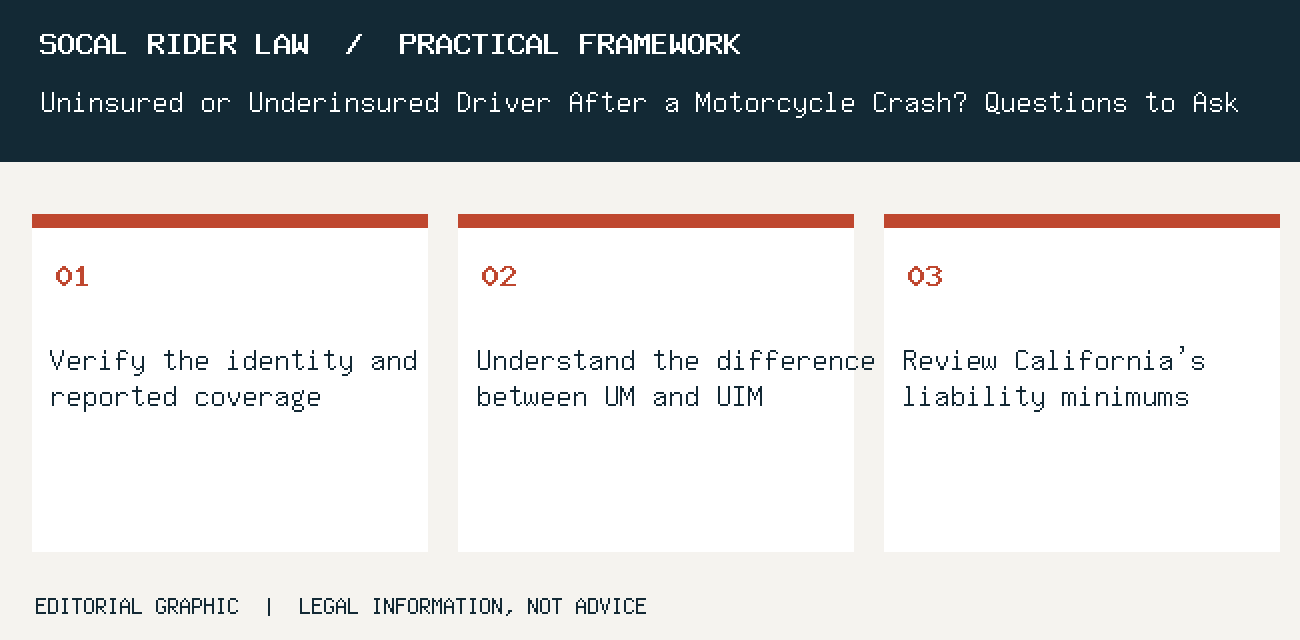
    Verify the identity and reported coverage; Understand the difference between UM and UIM; Review California's liability minimums
    Illustrated guide: Understand the difference between UM and UIM

    Look for other potentially applicable policies

    Coverage questions may involve a motorcycle policy, automobile coverage, household relationships, vehicle ownership or other sources. Keep decisions proportionate to the information available. Some matters require immediate attention, but a final release, formal allegation or other irreversible action deserves case-specific review. Preserve uncertainties rather than presenting them as settled facts.

    Provide qualified counsel with full policy documents rather than a short screenshot of limit numbers. The scene may change quickly as vehicles are removed, traffic resumes and weather shifts. Reliable photographs and notes can preserve context, but they should not put anyone in danger. Describe the source of every image and avoid assigning a conclusion the image alone cannot establish.

    A driver using a borrowed vehicle can raise coverage questions beyond a single insurance card.

    Do not assume that listing a possible policy means its terms will cover this incident.

    Preserve notices and insurer deadlines

    Policies may specify reporting, cooperation, arbitration or other procedural requirements for uninsured-motorist benefits.

    Record the date each insurer was notified, what was requested and the complete correspondence. Often the facts that matter most are not the ones initially debated. A disputed speed estimate, camera clock or lane position may later be clarified by an independent record. Maintain competing versions when they exist and identify what additional information could help evaluate them.

    A claim reported under one coverage part might still raise separate paperwork questions under another.

    Do not rely on informal calls as the only proof of timely notice when written confirmation is available.

    Document medical and financial consequences

    Treatment records, lost-work evidence and expense documents can help communicate the claimed impact. That distinction makes case review more precise.

    Maintain a dated treatment index, bills, insurance explanations, pay statements and relevant receipts. Documentation of costs should separate amounts billed, amounts paid, estimated future costs and balances in dispute. Attach the underlying invoice or statement to the summary. Accuracy matters more than inflating the size of the file with unverified totals.

    A medical bill may later be adjusted or paid in part by another source, requiring careful reconciliation.

    Do not add every charge into one figure without identifying payments and offsets.

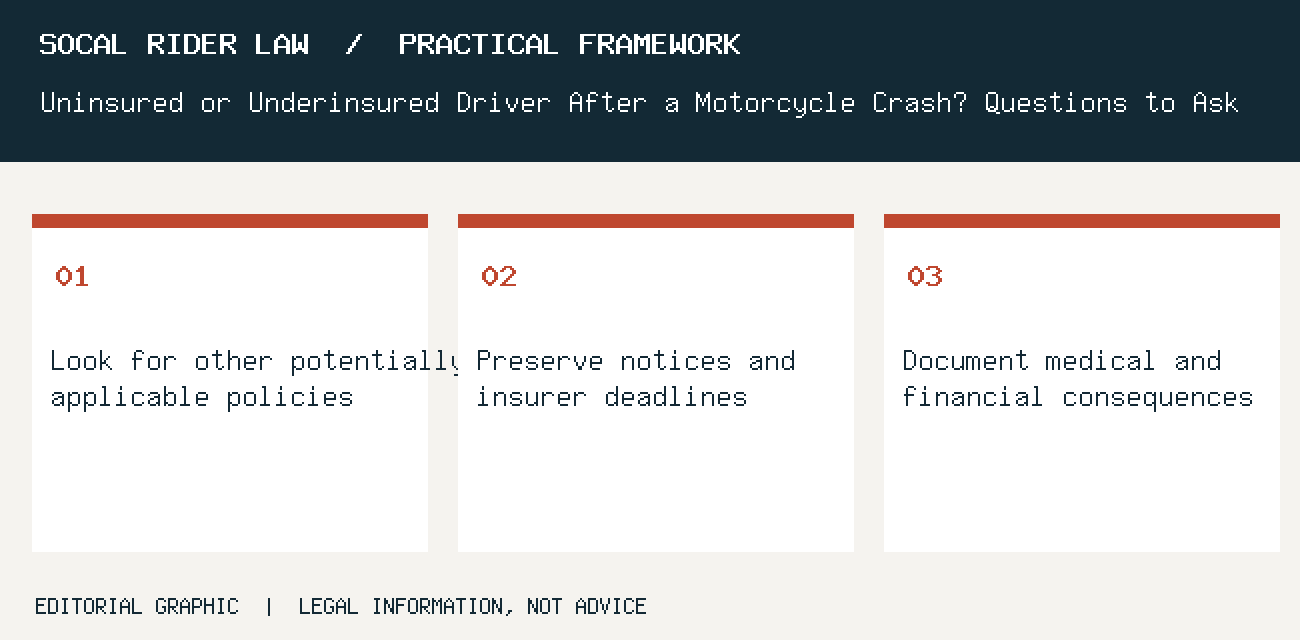
    Look for other potentially applicable policies; Preserve notices and insurer deadlines; Document medical and financial consequences
    Illustrated guide: Preserve notices and insurer deadlines

    Avoid premature assumptions about settlement

    The value of a potential claim can depend on evidence, coverage, injuries, fault and legal rules. Focus on what could be verified.

    Review proposed releases and written offers with an understanding of what claims they cover. An independent observer may have seen only part of the event. Preserve contact information and the witness’s own account without pressuring the person toward a preferred statement. A report from one angle can be important yet incomplete.

    An offer relating to property damage might have different terms from a bodily-injury resolution.

    Do not assume accepting one payment is always consequence-free or always a full release.

    Prepare the evidence of the collision itself

    Coverage analysis does not replace the need to evaluate what happened and each party’s conduct. Keep decisions proportionate to the information available.

    Keep original video, photos, vehicle damage, witness information and the official incident report reference. California roadway rules and insurance requirements provide context, not an automatic outcome for a specific accident. A rider’s conduct, another driver’s actions, the physical scene and applicable defenses all require review. Avoid generic statements that any single rule decides fault.

    A video may identify the vehicle’s direction but leave speed and visibility uncertain.

    Do not presume a lack of insurance proves fault for the crash.

    Get case-specific guidance on deadlines

    Civil limitations periods and contractual policy provisions are different legal questions that can interact.

    Organize incident dates, notices, policy language and any pending legal papers for prompt review. A useful consultation packet should be concise enough to navigate but complete enough to reveal uncertainties. Include a timeline, source index, key communications, major bills or estimates and an unanswered-question list. Early, organized review can identify next steps without promising recovery.

    A person may be handling medical treatment while an insurer communication requires a time-sensitive response.

    Do not use a generalized FAQ to calculate an individual deadline.

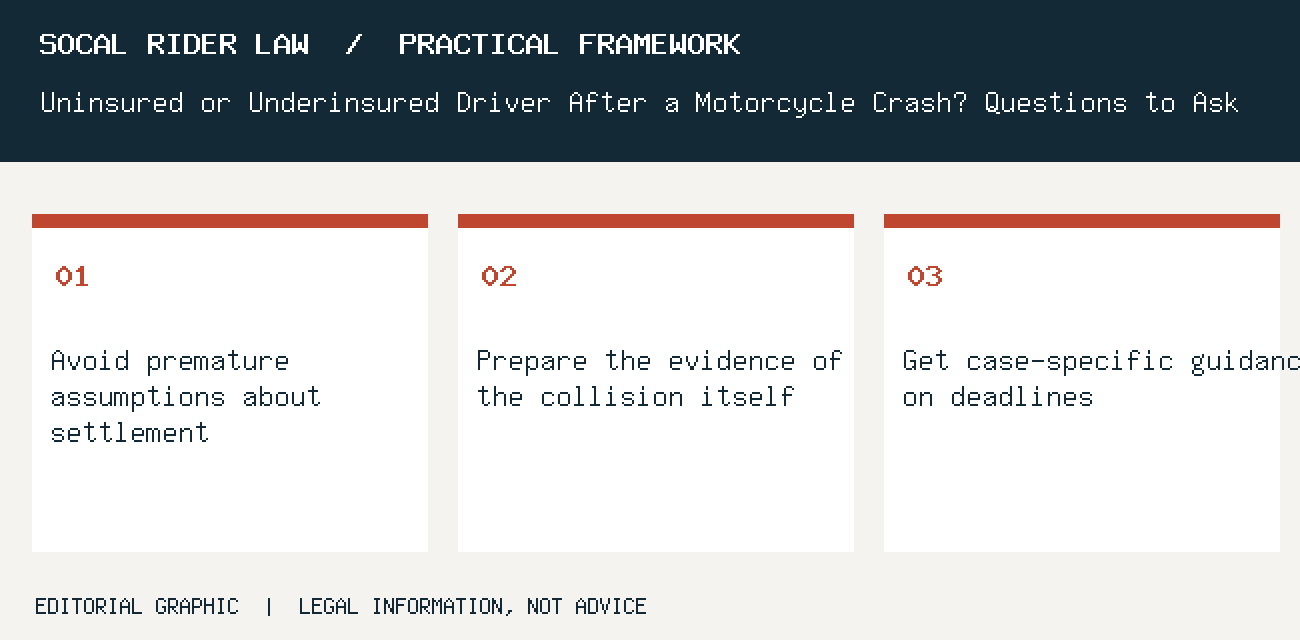
    Avoid premature assumptions about settlement; Prepare the evidence of the collision itself; Get case-specific guidance on deadlines
    Illustrated guide: Prepare the evidence of the collision itself

    Practical nine-point checklist

    1. Verify the identity and reported coverage: Preserve incident details, insurer names, policy or claim references and official correspondence.
    2. Understand the difference between UM and UIM: Obtain your declarations page, endorsements, exclusions, limits and relevant insurer communications.
    3. Review California’s liability minimums: Check the official DMV guidance and confirm the actual date, vehicle type and policy involved.
    4. Look for other potentially applicable policies: Provide qualified counsel with full policy documents rather than a short screenshot of limit numbers.
    5. Preserve notices and insurer deadlines: Record the date each insurer was notified, what was requested and the complete correspondence.
    6. Document medical and financial consequences: Maintain a dated treatment index, bills, insurance explanations, pay statements and relevant receipts.
    7. Avoid premature assumptions about settlement: Review proposed releases and written offers with an understanding of what claims they cover.
    8. Prepare the evidence of the collision itself: Keep original video, photos, vehicle damage, witness information and the official incident report reference.
    9. Get case-specific guidance on deadlines: Organize incident dates, notices, policy language and any pending legal papers for prompt review.
    Person reviewing a contract on a laptop, representing insurance claim and settlement documents
    Illustrative motorcycle and injury-related photograph from the SoCal Rider Law media library.

    Frequently asked questions

    What are the current California auto liability minimums?

    For many private passenger vehicles, DMV lists $30,000 per person, $60,000 per accident for bodily injury and $15,000 for property damage. The specific facts and official documents should be evaluated before any legal or coverage conclusion.

    Does my policy automatically cover an uninsured driver?

    No automatic conclusion applies; policy coverages and conditions require review.

    Can there be more than one potentially relevant policy?

    Sometimes, depending on the people, vehicles and policy provisions.

    Does lack of insurance prove the other driver caused the collision?

    No. Fault and coverage are separate issues.

    Official resource: California DMV: vehicle insurance requirements.

    General information, not legal or medical advice. No attorney-client relationship is created by reading this page, and no outcome is guaranteed. Timelines and remedies depend on specific facts and law.

    Questions after a motorcycle crash?

    Coverage, treatment and responsibility can be complicated. Request a case review based on your actual accident, insurance documents and concerns.
    Request case review

  • California Lane-Splitting Motorcycle Accidents: Rules, Evidence, and Common Questions

    California Lane-Splitting Motorcycle Accidents: Rules, Evidence, and Common Questions

    MOTORCYCLE & INJURY LAW / RESOURCES

    California Lane-Splitting Motorcycle Accidents: Rules, Evidence, and Common Questions

    California Lane-Splitting Motorcycle Accidents: Rules, Evidence, and Common Questions: a practical guide for riders and families.

    Practical legal informationOctober 28, 2026
    ← All Rider Law articles10 min read · October 2026

    Lane splitting often generates immediate disagreement after a motorcycle crash. Some drivers assume it is unlawful; others assume its legality establishes that a rider could not be responsible for an unsafe maneuver. Neither shortcut is sound. The California Highway Patrol describes lane splitting as legal when performed safely and prudently, and the DMV provides additional safety guidance. A collision still calls for a fact-specific analysis of speed, conditions, positioning, visibility and the behavior of everyone involved.

    Important: This guide is educational. In an emergency, follow medical and public-safety directions. Legal rights and coverage depend on the full evidence, policy documents, jurisdiction and timing.

    Know what lane splitting means

    California law recognizes motorcycles traveling between rows of stopped or moving vehicles; ordinary lane changes and shoulder use present different issues. Describe the observed event before explaining what you think caused it. Where available, identify the source, date and person involved. A reliable chronology is more valuable than an emphatic conclusion that overlooks the surrounding evidence.

    Describe the rider’s path, adjacent lanes and traffic conditions before assuming a particular legal label applies. Evidence is most useful when a reader can reconstruct when it was created and what it actually depicts. Save original photographs and recordings separately from annotated presentation copies. If a detail is uncertain, say so rather than attempting to make the sequence appear cleaner than the available evidence supports.

    A motorcycle moving between two lines of slowly moving cars may fit the common definition of lane splitting. Ask which source supports this part of the timeline and what might explain the same event differently. A careful record should preserve the original material and identify uncertainty rather than hiding it.

    Do not confuse lawful lane splitting with a blanket immunity from ordinary safety obligations. Before taking a difficult-to-reverse action, review the relevant record and consult an appropriate professional. Document who will follow up, what information is missing and whether a legal or insurance deadline may require prompt attention.

    Consider relative and absolute speed

    CHP safety guidance warns that higher speeds and larger speed differences increase danger during lane splitting. Separate records that document an event from interpretations of legal responsibility. A photograph, witness statement or policy letter may support one part of the account without proving everything. That distinction makes case review more precise.

    Record estimates cautiously and preserve any objective measurements or video that may clarify movement. Health and immediate safety are not interchangeable with legal strategy. Clinicians and emergency responders address medical concerns, and qualified legal counsel can assess possible claims, deadlines and evidence needs. Keep those roles distinct even when a serious collision makes many decisions feel urgent.

    A rider passing stopped traffic at one speed presents different factual questions from passing fast-moving vehicles.

    Do not infer exact speed from damage alone or from an emotional eyewitness description.

    Document lane positions and traffic density

    Lane width, road curves, vehicle spacing and congestion can affect available movement and sight lines. Focus on what could be verified. Is there an original recording, a dated report, a clinical record or a financial statement? If the answer is no, identify the missing material and consider whether it can be lawfully requested.

    Note lane count, position of adjacent vehicles, divider markings and whether traffic was stopped or moving. Insurance communications can contain policy numbers, adjuster references, estimates and requests for information. Maintain a dated communication log and retain the original letters, forms and attachments. That record can help a reviewer find exactly what was requested and when.

    A mirror collision between adjacent vehicles may have occurred during a lane change rather than steady travel.

    Do not treat a simplified illustration as a scale reconstruction of the incident.

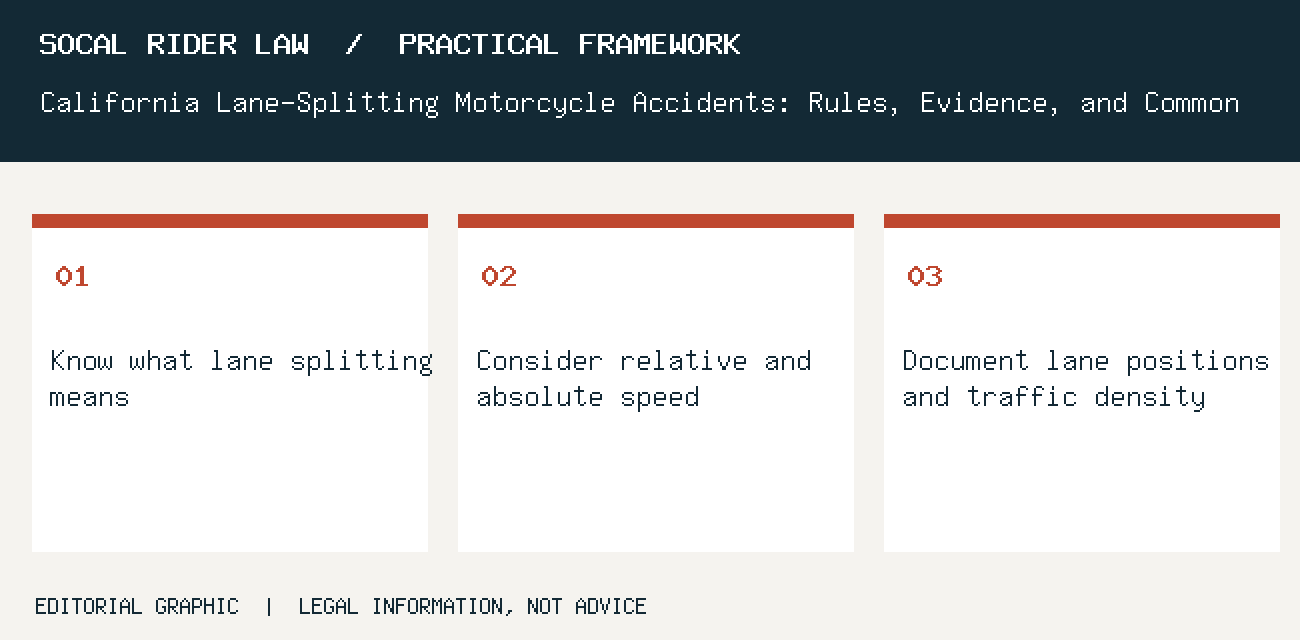
    Know what lane splitting means; Consider relative and absolute speed; Document lane positions and traffic density
    Illustrated guide: Consider relative and absolute speed

    Identify adjacent driver maneuvers

    A car may change lanes, drift, open a door or enter traffic while a motorcycle travels nearby. Keep decisions proportionate to the information available. Some matters require immediate attention, but a final release, formal allegation or other irreversible action deserves case-specific review. Preserve uncertainties rather than presenting them as settled facts.

    Preserve turn signal observations, video, witness statements and relevant vehicle damage. The scene may change quickly as vehicles are removed, traffic resumes and weather shifts. Reliable photographs and notes can preserve context, but they should not put anyone in danger. Describe the source of every image and avoid assigning a conclusion the image alone cannot establish.

    A sudden lane change can be relevant even if the driver later says no motorcycle was visible.

    Do not assume every change of lane establishes fault without the surrounding sequence.

    Preserve footage and physical context

    Helmet cameras and nearby vehicle cameras can show relative movement but may distort perceived speed or distance.

    Save original recordings, note camera mounting and preserve the approach before and after the event. Often the facts that matter most are not the ones initially debated. A disputed speed estimate, camera clock or lane position may later be clarified by an independent record. Maintain competing versions when they exist and identify what additional information could help evaluate them.

    A wide-angle camera may make adjacent vehicles appear farther away than they were.

    Do not make editing the only version of a clip used in a claim discussion.

    Track roadway and weather conditions

    Rain, debris, construction work, lighting and glare can affect traction and visibility. That distinction makes case review more precise.

    Record weather, time of day, road surface, markings, construction signs and photographs. Documentation of costs should separate amounts billed, amounts paid, estimated future costs and balances in dispute. Attach the underlying invoice or statement to the summary. Accuracy matters more than inflating the size of the file with unverified totals.

    A narrow work-zone lane may change the available space compared with ordinary freeway conditions.

    Do not attribute the collision to weather without evidence connecting conditions to the event.

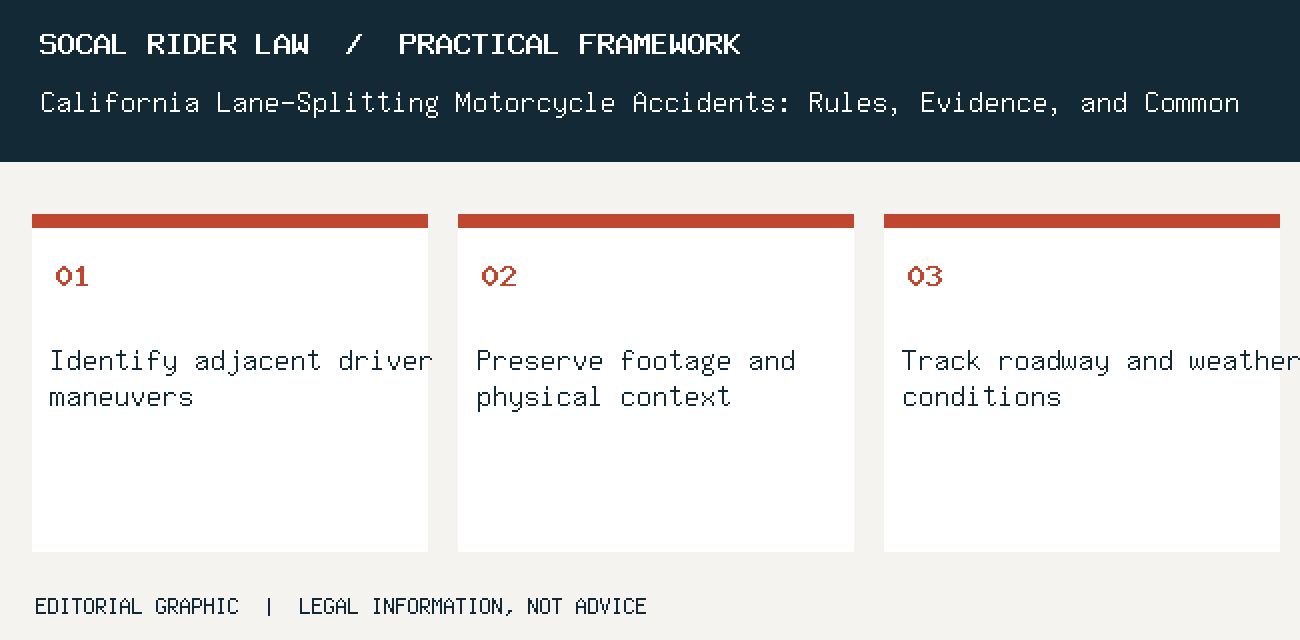
    Identify adjacent driver maneuvers; Preserve footage and physical context; Track roadway and weather conditions
    Illustrated guide: Preserve footage and physical context

    Understand comparative fault as a possibility

    California injury cases can involve assessment of conduct by more than one person; labels alone do not resolve allocation. Focus on what could be verified.

    Gather facts bearing on both rider and driver behavior without deciding the final legal percentage yourself. An independent observer may have seen only part of the event. Preserve contact information and the witness’s own account without pressuring the person toward a preferred statement. A report from one angle can be important yet incomplete.

    A driver who failed to check a mirror and a rider moving unsafely may both raise questions requiring review.

    Do not accept a proposed blame percentage merely because an adjuster states it confidently.

    Handle insurance communications precisely

    Insurers may ask whether the rider was splitting lanes and request recorded details before full evidence is available. Keep decisions proportionate to the information available.

    Record the questions asked, provide accurate information and review statement or release requests appropriately. California roadway rules and insurance requirements provide context, not an automatic outcome for a specific accident. A rider’s conduct, another driver’s actions, the physical scene and applicable defenses all require review. Avoid generic statements that any single rule decides fault.

    A claimant may know they were between lanes but not accurately recall the speed of every nearby vehicle.

    Do not speculate about measurements or let a recording replace a full factual investigation.

    A useful review focuses on the exact positions, video sources, injuries, insurance policies and looming deadlines.

    Bring a timeline, available camera files, photographs, report reference and details of insurer contact. A useful consultation packet should be concise enough to navigate but complete enough to reveal uncertainties. Include a timeline, source index, key communications, major bills or estimates and an unanswered-question list. Early, organized review can identify next steps without promising recovery.

    The attorney can identify missing evidence and discuss possible next steps without promising a case value.

    Do not assume that legality alone establishes the outcome of a negligence or insurance analysis.

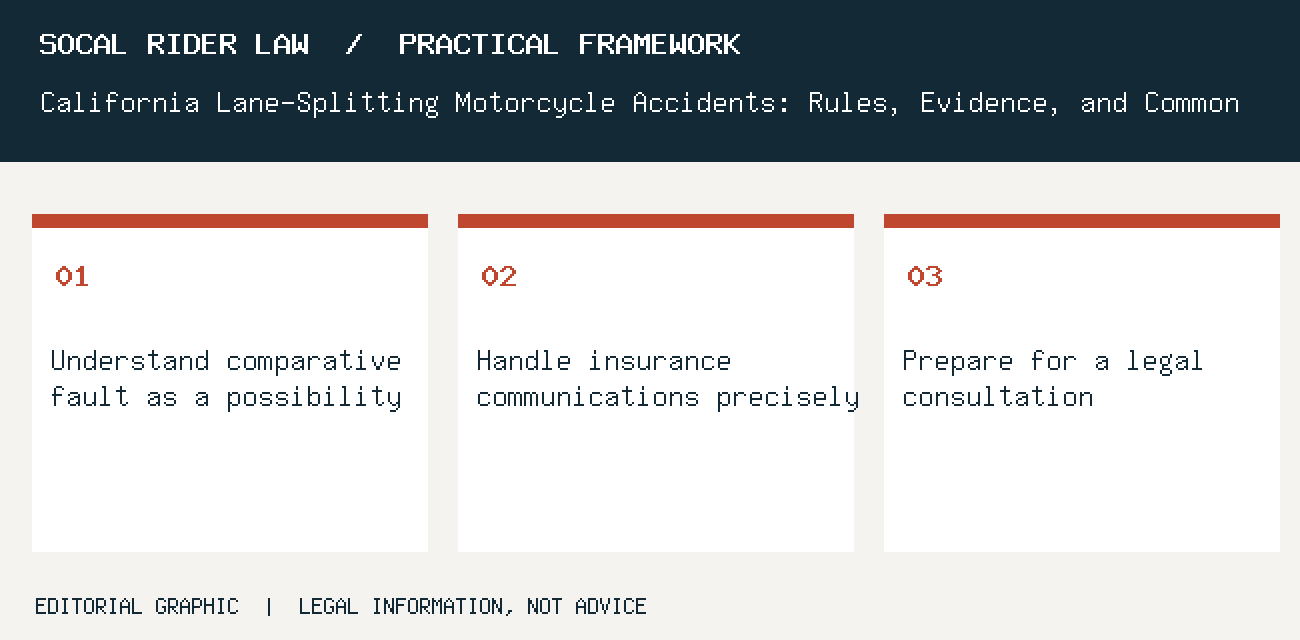
    Understand comparative fault as a possibility; Handle insurance communications precisely; Prepare for a legal consultation
    Illustrated guide: Handle insurance communications precisely

    Practical nine-point checklist

    1. Know what lane splitting means: Describe the rider’s path, adjacent lanes and traffic conditions before assuming a particular legal label applies.
    2. Consider relative and absolute speed: Record estimates cautiously and preserve any objective measurements or video that may clarify movement.
    3. Document lane positions and traffic density: Note lane count, position of adjacent vehicles, divider markings and whether traffic was stopped or moving.
    4. Identify adjacent driver maneuvers: Preserve turn signal observations, video, witness statements and relevant vehicle damage.
    5. Preserve footage and physical context: Save original recordings, note camera mounting and preserve the approach before and after the event.
    6. Track roadway and weather conditions: Record weather, time of day, road surface, markings, construction signs and photographs.
    7. Understand comparative fault as a possibility: Gather facts bearing on both rider and driver behavior without deciding the final legal percentage yourself.
    8. Handle insurance communications precisely: Record the questions asked, provide accurate information and review statement or release requests appropriately.
    9. Prepare for a legal consultation: Bring a timeline, available camera files, photographs, report reference and details of insurer contact.
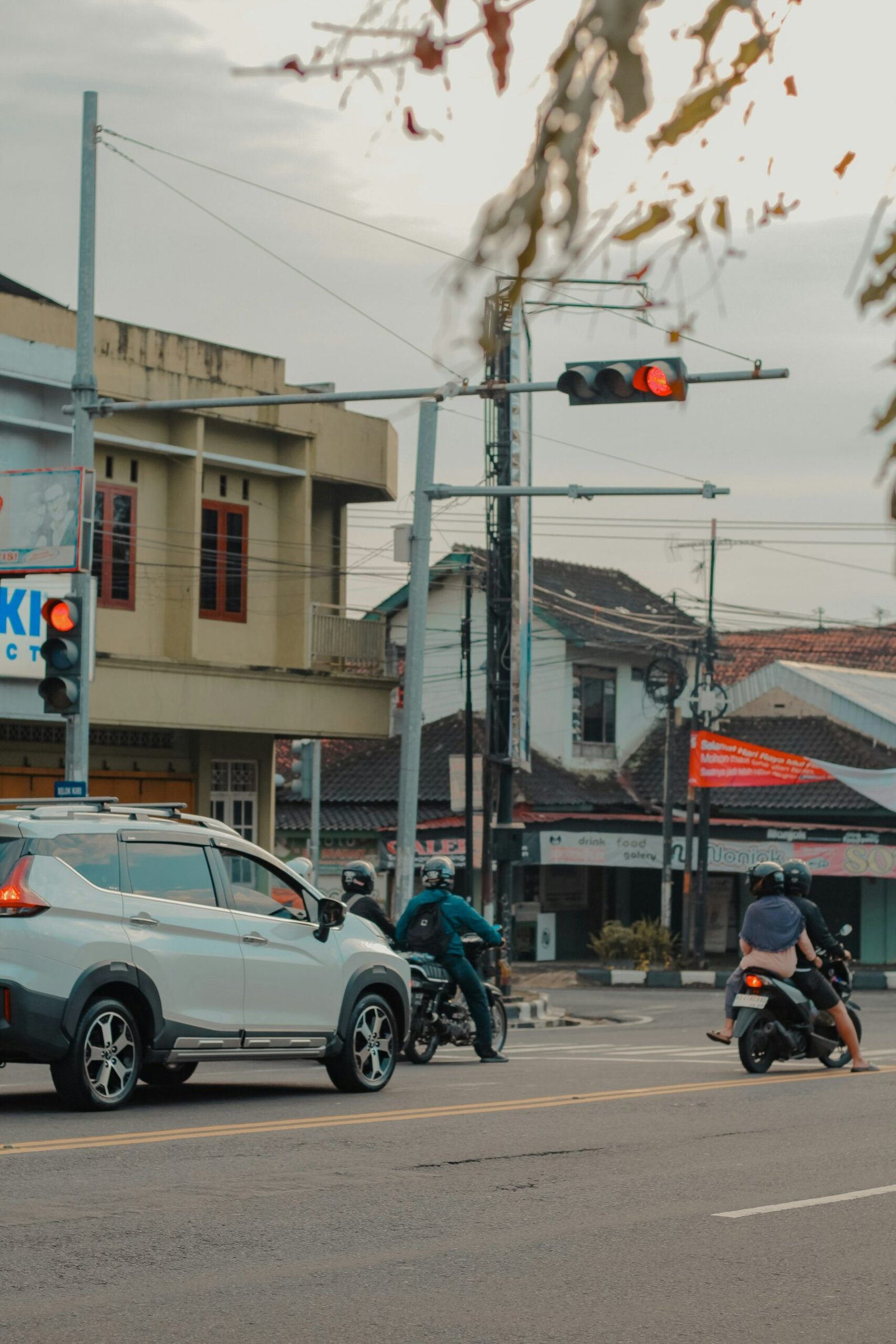
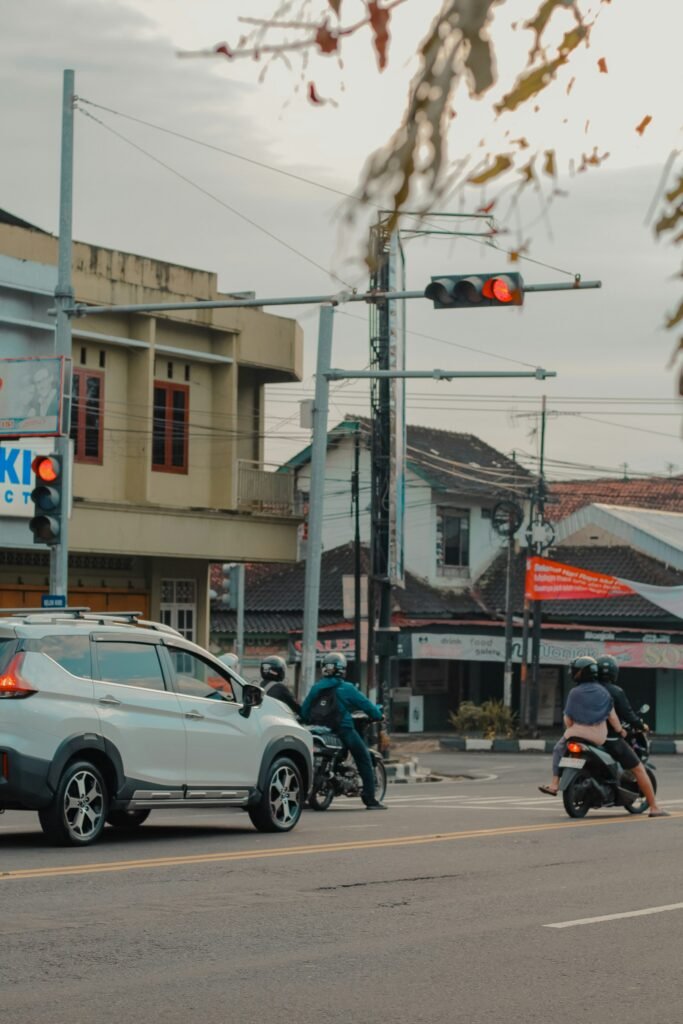
    Cars and motorcycles at a traffic light intersection, representing visibility and shared-road responsibility
    Illustrative motorcycle and injury-related photograph from the SoCal Rider Law media library.

    Frequently asked questions

    Is lane splitting legal in California?

    Yes, California authorities recognize legal lane splitting; safety, prudence and the particular facts still matter. The specific facts and official documents should be evaluated before any legal or coverage conclusion.

    Does lane splitting automatically make a rider at fault?

    No. There is no automatic fault outcome simply from the label.

    What is comparative fault?

    It is a framework for examining the conduct of multiple participants; legal application depends on case-specific facts.

    What if the car changed lanes without signaling?

    Preserve relevant evidence and evaluate all movements; one reported violation does not substitute for a full review.

    Official resource: California CHP motorcycle safety and lane splitting.

    General information, not legal or medical advice. No attorney-client relationship is created by reading this page, and no outcome is guaranteed. Timelines and remedies depend on specific facts and law.

    Questions after a motorcycle crash?

    Coverage, treatment and responsibility can be complicated. Request a case review based on your actual accident, insurance documents and concerns.

    Request case review

  • Left-Turn Motorcycle Crashes: The Evidence That Can Clarify What Happened

    Left-Turn Motorcycle Crashes: The Evidence That Can Clarify What Happened

    MOTORCYCLE & INJURY LAW / RESOURCES

    Left-Turn Motorcycle Crashes: The Evidence That Can Clarify What Happened

    Left-Turn Motorcycle Crashes: The Evidence That Can Clarify What Happened: a practical guide for riders and families.

    Practical legal informationOctober 28, 2026
    ← All Rider Law articles10 min read · October 2026

    A common motorcycle collision scenario involves a vehicle turning left across a rider’s path. The immediate aftermath can be confusing, especially when the driver says the motorcycle appeared suddenly or the rider and witnesses describe different speeds and distances. No single photograph or statement necessarily determines fault. A careful investigation looks at the intersection, vehicle movements, visibility, timing and applicable rules. This guide explains practical ways to preserve relevant evidence while emphasizing immediate safety and appropriate medical care.

    Important: This guide is educational. In an emergency, follow medical and public-safety directions. Legal rights and coverage depend on the full evidence, policy documents, jurisdiction and timing.

    Prioritize safety, reporting and care

    Motorcycle crashes can involve vulnerable road users and hazardous intersections, so health and safety come before evidence collection. Describe the observed event before explaining what you think caused it. Where available, identify the source, date and person involved. A reliable chronology is more valuable than an emphatic conclusion that overlooks the surrounding evidence.

    Move away from active traffic when safe, call for emergency assistance where needed and follow reporting directions. Evidence is most useful when a reader can reconstruct when it was created and what it actually depicts. Save original photographs and recordings separately from annotated presentation copies. If a detail is uncertain, say so rather than attempting to make the sequence appear cleaner than the available evidence supports.

    A rider who is injured should not attempt to walk into moving traffic to photograph a vehicle’s final position. Ask which source supports this part of the timeline and what might explain the same event differently. A careful record should preserve the original material and identify uncertainty rather than hiding it.

    Do not delay urgent treatment or confront another road user to obtain a statement. Before taking a difficult-to-reverse action, review the relevant record and consult an appropriate professional. Document who will follow up, what information is missing and whether a legal or insurance deadline may require prompt attention.

    Map the exact intersection

    The number of lanes, signal phases, turn pockets, medians and sight lines can affect the sequence of a left-turn event. Separate records that document an event from interpretations of legal responsibility. A photograph, witness statement or policy letter may support one part of the account without proving everything. That distinction makes case review more precise.

    Record the street names, travel directions, lane markings, traffic controls and nearby landmarks. Health and immediate safety are not interchangeable with legal strategy. Clinicians and emergency responders address medical concerns, and qualified legal counsel can assess possible claims, deadlines and evidence needs. Keep those roles distinct even when a serious collision makes many decisions feel urgent.

    A vehicle may turn from a dedicated left-turn lane, a center lane or an uncontrolled driveway.

    Do not rely on a generic map image to prove the exact traffic-control condition at the time.

    Preserve signal and visibility context

    Light conditions, sun glare, stopped traffic, vehicle size and parked obstructions may shape what each participant could see. Focus on what could be verified. Is there an original recording, a dated report, a clinical record or a financial statement? If the answer is no, identify the missing material and consider whether it can be lawfully requested.

    Keep timestamped photos showing each direction of approach and identify possible camera locations. Insurance communications can contain policy numbers, adjuster references, estimates and requests for information. Maintain a dated communication log and retain the original letters, forms and attachments. That record can help a reviewer find exactly what was requested and when.

    A tall vehicle in an adjacent lane might obscure the line of sight before a turn.

    Do not treat a claimed failure to see the motorcycle as proof of a legal conclusion by itself.

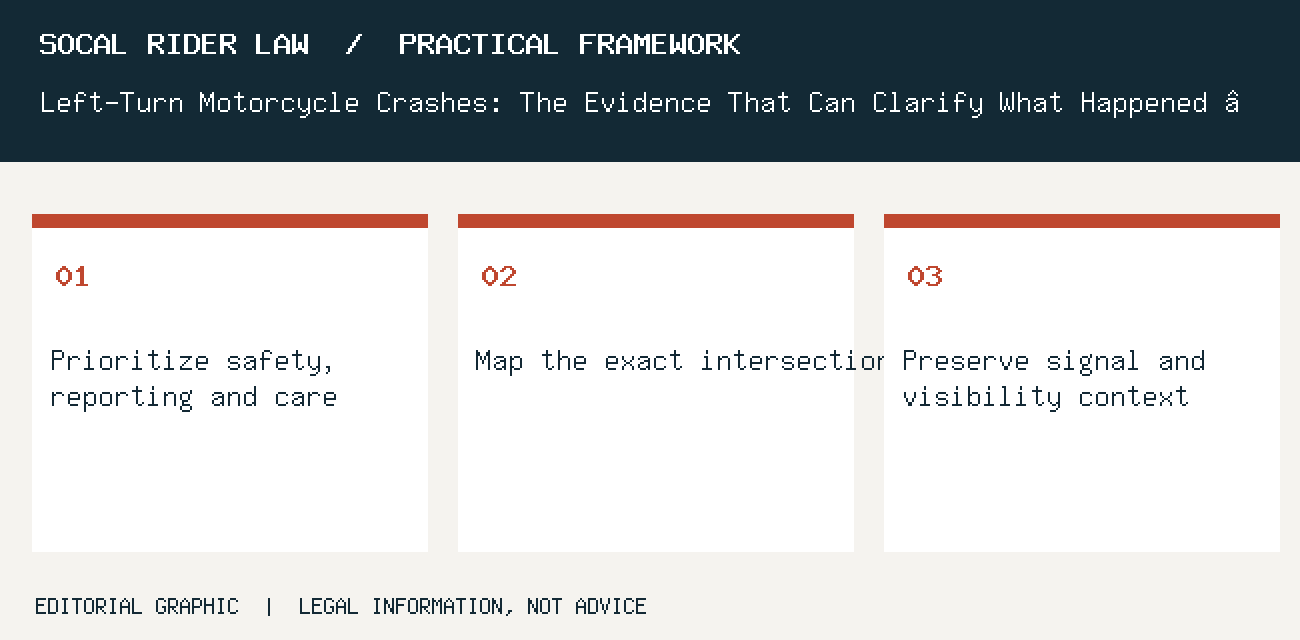
    Prioritize safety, reporting and care; Map the exact intersection; Preserve signal and visibility context
    Illustrated guide: Map the exact intersection

    Identify the vehicle movements

    Understanding where each party traveled before impact may require more than their statements after the collision. Keep decisions proportionate to the information available. Some matters require immediate attention, but a final release, formal allegation or other irreversible action deserves case-specific review. Preserve uncertainties rather than presenting them as settled facts.

    Document reported directions, claimed speeds, turning path, braking, points of contact and final positions. The scene may change quickly as vehicles are removed, traffic resumes and weather shifts. Reliable photographs and notes can preserve context, but they should not put anyone in danger. Describe the source of every image and avoid assigning a conclusion the image alone cannot establish.

    Damage to one part of a vehicle may support a sequence hypothesis without conclusively establishing every movement.

    Avoid calculating speed from a single photo without qualified analysis.

    Save recordings before overwriting

    Dashcams, helmet cameras, nearby security systems and witness footage can disappear quickly.

    Preserve complete original files and note their owners, retention practices and approximate camera clocks. Often the facts that matter most are not the ones initially debated. A disputed speed estimate, camera clock or lane position may later be clarified by an independent record. Maintain competing versions when they exist and identify what additional information could help evaluate them.

    A business’s surveillance system may overwrite footage before a later insurance request arrives.

    Do not alter original footage or assume every private recording can be accessed without appropriate permission.

    Collect witnesses and incident records

    Independent observations may describe a signal phase, turning movement or audible braking not captured in photos. That distinction makes case review more precise.

    Record witness contact details, reporting agency, report number and officers’ identifying information where available. Documentation of costs should separate amounts billed, amounts paid, estimated future costs and balances in dispute. Attach the underlying invoice or statement to the summary. Accuracy matters more than inflating the size of the file with unverified totals.

    A witness standing at a bus stop may have seen the approach but not the precise point of impact.

    Do not pressure witnesses to adopt a particular interpretation or paraphrase them inaccurately.

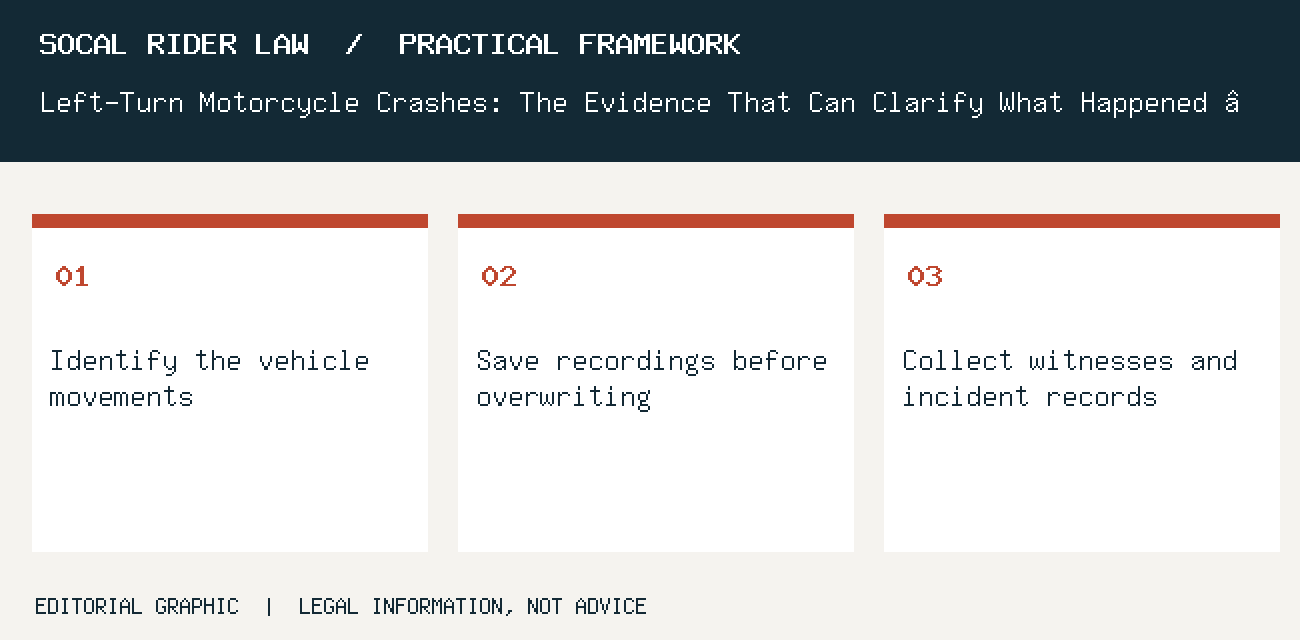
    Identify the vehicle movements; Save recordings before overwriting; Collect witnesses and incident records
    Illustrated guide: Save recordings before overwriting

    Document protective gear and motorcycle damage

    Riding equipment and damage patterns can help reconstruct consequences and preserve physical evidence. Focus on what could be verified.

    Keep photographs of the bike, helmet, jacket, gloves, accessories and any relevant damaged components. An independent observer may have seen only part of the event. Preserve contact information and the witness’s own account without pressuring the person toward a preferred statement. A report from one angle can be important yet incomplete.

    A helmet can show impact marks, but clinical and technical conclusions require appropriate professionals.

    Do not continue using safety equipment believed to be compromised without appropriate safety assessment.

    Track treatment and practical consequences

    A crash can disrupt care, work, transportation and ordinary responsibilities over an extended period. Keep decisions proportionate to the information available.

    Maintain medical visit dates, clinician guidance, vehicle estimates, receipts and work records. California roadway rules and insurance requirements provide context, not an automatic outcome for a specific accident. A rider’s conduct, another driver’s actions, the physical scene and applicable defenses all require review. Avoid generic statements that any single rule decides fault.

    A transportation receipt may relate to an appointment while a lost-work claim needs separate payroll support.

    Do not assume every expense is automatically recoverable or alter care based on claims considerations.

    Prepare a focused claim review

    A legal review should connect available facts, missing evidence and potential deadlines without promising an outcome.

    Bring the intersection map, initial incident timeline, original recordings, photos and insurance communications. A useful consultation packet should be concise enough to navigate but complete enough to reveal uncertainties. Include a timeline, source index, key communications, major bills or estimates and an unanswered-question list. Early, organized review can identify next steps without promising recovery.

    A clear chronology can flag conflicting statements that should be checked rather than resolved by assumption.

    Do not overlook possible time limits, public-entity issues or insurer notice obligations.

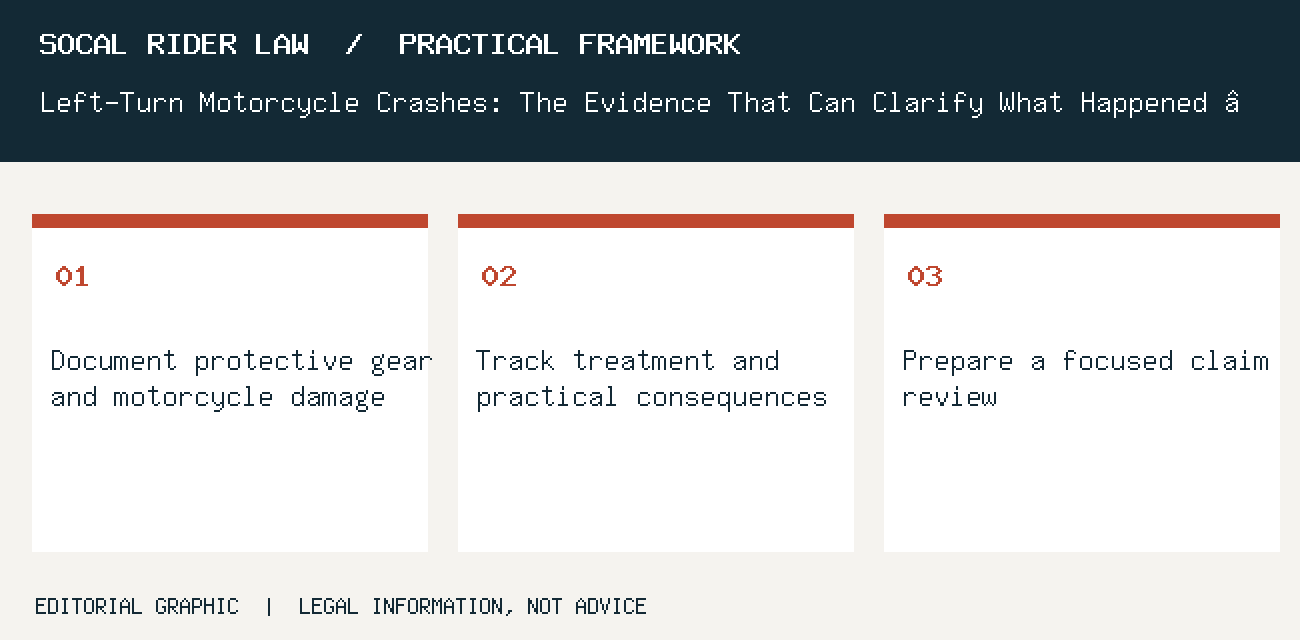
    Document protective gear and motorcycle damage; Track treatment and practical consequences; Prepare a focused claim review
    Illustrated guide: Track treatment and practical consequences

    Practical nine-point checklist

    1. Prioritize safety, reporting and care: Move away from active traffic when safe, call for emergency assistance where needed and follow reporting directions.
    2. Map the exact intersection: Record the street names, travel directions, lane markings, traffic controls and nearby landmarks.
    3. Preserve signal and visibility context: Keep timestamped photos showing each direction of approach and identify possible camera locations.
    4. Identify the vehicle movements: Document reported directions, claimed speeds, turning path, braking, points of contact and final positions.
    5. Save recordings before overwriting: Preserve complete original files and note their owners, retention practices and approximate camera clocks.
    6. Collect witnesses and incident records: Record witness contact details, reporting agency, report number and officers’ identifying information where available.
    7. Document protective gear and motorcycle damage: Keep photographs of the bike, helmet, jacket, gloves, accessories and any relevant damaged components.
    8. Track treatment and practical consequences: Maintain medical visit dates, clinician guidance, vehicle estimates, receipts and work records.
    9. Prepare a focused claim review: Bring the intersection map, initial incident timeline, original recordings, photos and insurance communications.
    Motorcyclist in protective gear waiting at an intersection, representing Southern California motorcycle collision and visibility issues
    Illustrative motorcycle and injury-related photograph from the SoCal Rider Law media library.

    Frequently asked questions

    Is the turning driver always at fault?

    Not automatically. The circumstances, roadway rules, actions of all parties and evidence require evaluation. The specific facts and official documents should be evaluated before any legal or coverage conclusion.

    Is video necessary for an injury claim?

    Not always. Reports, witness accounts, physical evidence and other records can also matter.

    What if the driver says they did not see the rider?

    That is a factual statement to evaluate alongside visibility conditions and the full sequence of events.

    Should the motorcycle be repaired immediately?

    Safety, storage and insurance considerations matter. Discuss preserving relevant damage evidence before substantial alterations when feasible.

    Official resource: California DMV: sharing the road with motorcycles.

    General information, not legal or medical advice. No attorney-client relationship is created by reading this page, and no outcome is guaranteed. Timelines and remedies depend on specific facts and law.

    Questions after a motorcycle crash?

    Coverage, treatment and responsibility can be complicated. Request a case review based on your actual accident, insurance documents and concerns.

    Request case review