
Uninsured or Underinsured Driver After a Motorcycle Crash? Questions to Ask About Coverage
Uninsured or Underinsured Driver After a Motorcycle Crash? Questions to Ask About Coverage: a practical guide for riders and families.
A serious motorcycle crash is difficult enough without discovering that another driver may have no insurance or not enough coverage for the losses involved. The label uninsured or underinsured can describe different coverage situations, and the policy language matters. California’s current minimum liability limits for many private passenger vehicles are $30,000 per injured person, $60,000 per occurrence for bodily injury and $15,000 for property damage, but a minimum limit is not the same thing as adequate compensation. This guide focuses on records and coverage questions, not a prediction of benefits.
Important: This guide is educational. In an emergency, follow medical and public-safety directions. Legal rights and coverage depend on the full evidence, policy documents, jurisdiction and timing.
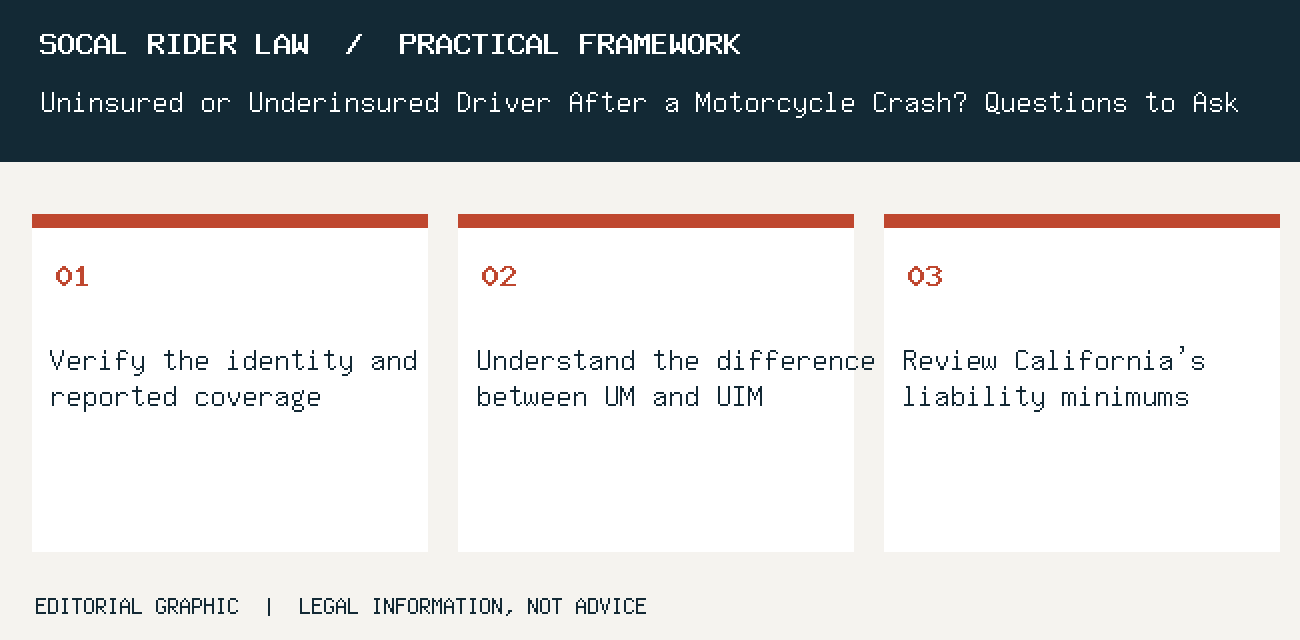
Verify the identity and reported coverage
The information exchanged at a scene may be incomplete, outdated or refer to a vehicle’s different driver. Describe the observed event before explaining what you think caused it. Where available, identify the source, date and person involved. A reliable chronology is more valuable than an emphatic conclusion that overlooks the surrounding evidence.
Preserve incident details, insurer names, policy or claim references and official correspondence. Evidence is most useful when a reader can reconstruct when it was created and what it actually depicts. Save original photographs and recordings separately from annotated presentation copies. If a detail is uncertain, say so rather than attempting to make the sequence appear cleaner than the available evidence supports.
A driver may produce an expired card even though another policy potentially applies. Ask which source supports this part of the timeline and what might explain the same event differently. A careful record should preserve the original material and identify uncertainty rather than hiding it.
Do not conclude that no coverage exists from one unanswered call or an informal statement. Before taking a difficult-to-reverse action, review the relevant record and consult an appropriate professional. Document who will follow up, what information is missing and whether a legal or insurance deadline may require prompt attention.
Understand the difference between UM and UIM
Uninsured motorist and underinsured motorist coverage can respond to different gaps subject to policy terms. Separate records that document an event from interpretations of legal responsibility. A photograph, witness statement or policy letter may support one part of the account without proving everything. That distinction makes case review more precise.
Obtain your declarations page, endorsements, exclusions, limits and relevant insurer communications. Health and immediate safety are not interchangeable with legal strategy. Clinicians and emergency responders address medical concerns, and qualified legal counsel can assess possible claims, deadlines and evidence needs. Keep those roles distinct even when a serious collision makes many decisions feel urgent.
Another driver’s policy may exist but have limits that do not address all documented losses.
Do not assume every motorcycle policy includes the same coverage, deductibles or conditions.
Review California’s liability minimums
Minimum liability limits describe the financial responsibility required for many vehicles but do not define an individual claim’s value. Focus on what could be verified. Is there an original recording, a dated report, a clinical record or a financial statement? If the answer is no, identify the missing material and consider whether it can be lawfully requested.
Check the official DMV guidance and confirm the actual date, vehicle type and policy involved. Insurance communications can contain policy numbers, adjuster references, estimates and requests for information. Maintain a dated communication log and retain the original letters, forms and attachments. That record can help a reviewer find exactly what was requested and when.
California DMV lists current private-passenger minimums of $30,000, $60,000 and $15,000 for the respective categories.
Do not treat statutory minimums as a guarantee that the other driver’s insurer will accept liability or pay the limit.
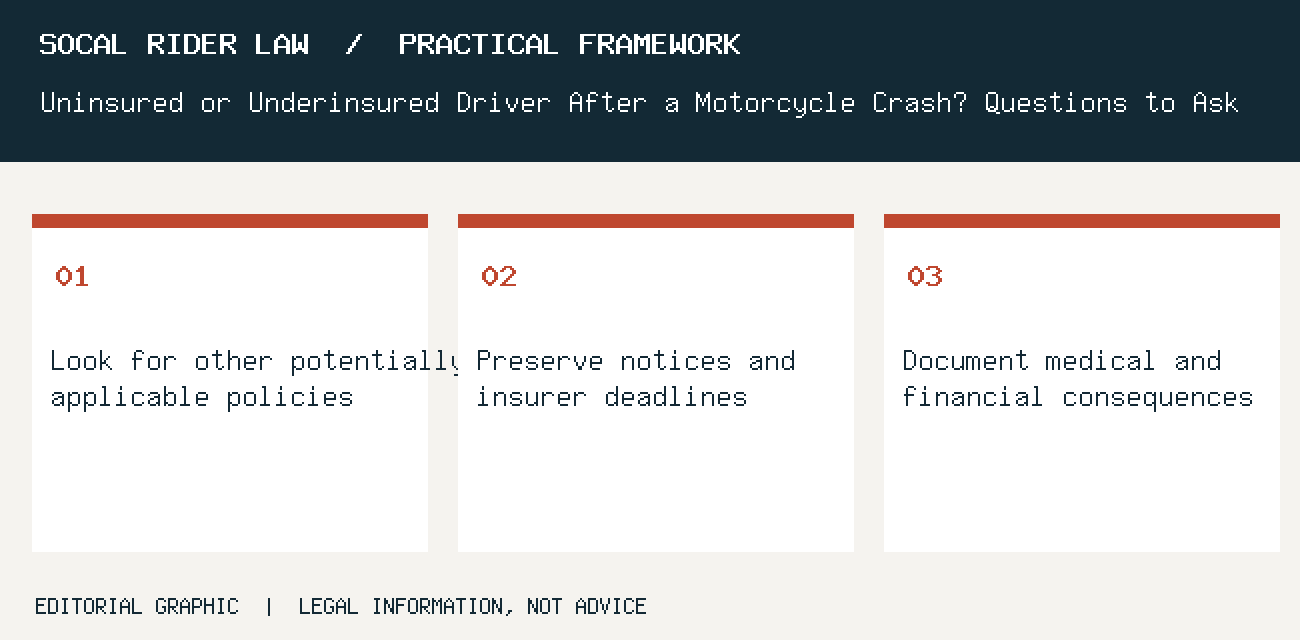
Look for other potentially applicable policies
Coverage questions may involve a motorcycle policy, automobile coverage, household relationships, vehicle ownership or other sources. Keep decisions proportionate to the information available. Some matters require immediate attention, but a final release, formal allegation or other irreversible action deserves case-specific review. Preserve uncertainties rather than presenting them as settled facts.
Provide qualified counsel with full policy documents rather than a short screenshot of limit numbers. The scene may change quickly as vehicles are removed, traffic resumes and weather shifts. Reliable photographs and notes can preserve context, but they should not put anyone in danger. Describe the source of every image and avoid assigning a conclusion the image alone cannot establish.
A driver using a borrowed vehicle can raise coverage questions beyond a single insurance card.
Do not assume that listing a possible policy means its terms will cover this incident.
Preserve notices and insurer deadlines
Policies may specify reporting, cooperation, arbitration or other procedural requirements for uninsured-motorist benefits.
Record the date each insurer was notified, what was requested and the complete correspondence. Often the facts that matter most are not the ones initially debated. A disputed speed estimate, camera clock or lane position may later be clarified by an independent record. Maintain competing versions when they exist and identify what additional information could help evaluate them.
A claim reported under one coverage part might still raise separate paperwork questions under another.
Do not rely on informal calls as the only proof of timely notice when written confirmation is available.
Document medical and financial consequences
Treatment records, lost-work evidence and expense documents can help communicate the claimed impact. That distinction makes case review more precise.
Maintain a dated treatment index, bills, insurance explanations, pay statements and relevant receipts. Documentation of costs should separate amounts billed, amounts paid, estimated future costs and balances in dispute. Attach the underlying invoice or statement to the summary. Accuracy matters more than inflating the size of the file with unverified totals.
A medical bill may later be adjusted or paid in part by another source, requiring careful reconciliation.
Do not add every charge into one figure without identifying payments and offsets.
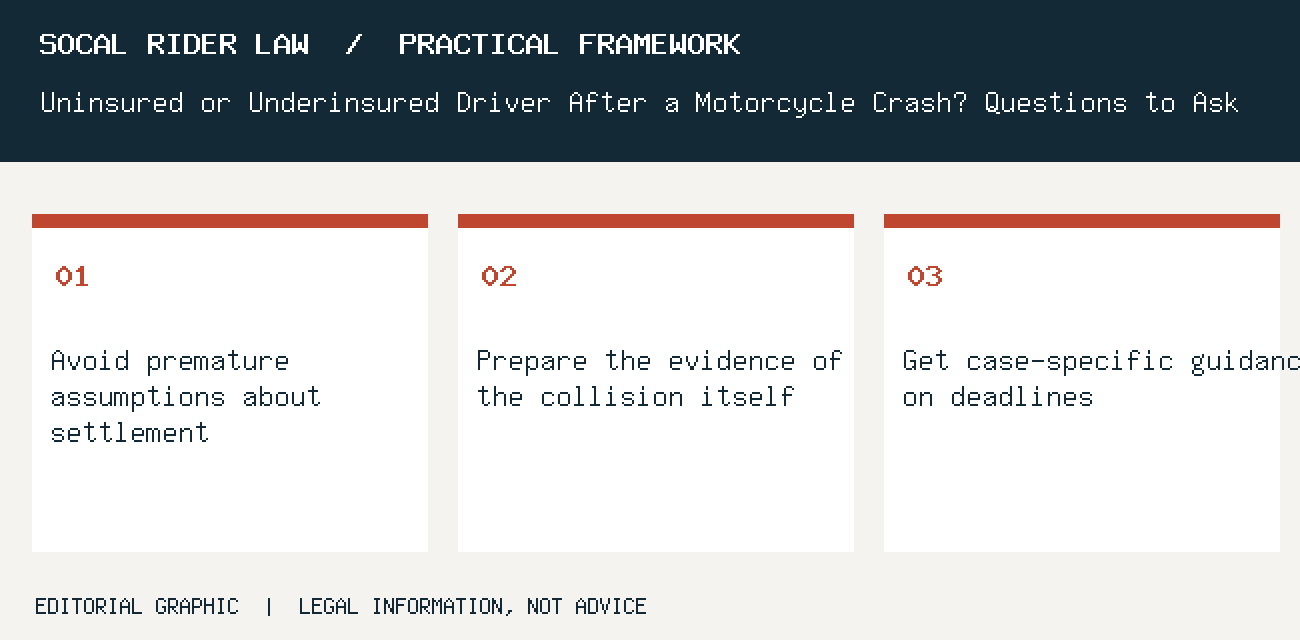
Avoid premature assumptions about settlement
The value of a potential claim can depend on evidence, coverage, injuries, fault and legal rules. Focus on what could be verified.
Review proposed releases and written offers with an understanding of what claims they cover. An independent observer may have seen only part of the event. Preserve contact information and the witness’s own account without pressuring the person toward a preferred statement. A report from one angle can be important yet incomplete.
An offer relating to property damage might have different terms from a bodily-injury resolution.
Do not assume accepting one payment is always consequence-free or always a full release.
Prepare the evidence of the collision itself
Coverage analysis does not replace the need to evaluate what happened and each party’s conduct. Keep decisions proportionate to the information available.
Keep original video, photos, vehicle damage, witness information and the official incident report reference. California roadway rules and insurance requirements provide context, not an automatic outcome for a specific accident. A rider’s conduct, another driver’s actions, the physical scene and applicable defenses all require review. Avoid generic statements that any single rule decides fault.
A video may identify the vehicle’s direction but leave speed and visibility uncertain.
Do not presume a lack of insurance proves fault for the crash.
Get case-specific guidance on deadlines
Civil limitations periods and contractual policy provisions are different legal questions that can interact.
Organize incident dates, notices, policy language and any pending legal papers for prompt review. A useful consultation packet should be concise enough to navigate but complete enough to reveal uncertainties. Include a timeline, source index, key communications, major bills or estimates and an unanswered-question list. Early, organized review can identify next steps without promising recovery.
A person may be handling medical treatment while an insurer communication requires a time-sensitive response.
Do not use a generalized FAQ to calculate an individual deadline.
Practical nine-point checklist
- Verify the identity and reported coverage: Preserve incident details, insurer names, policy or claim references and official correspondence.
- Understand the difference between UM and UIM: Obtain your declarations page, endorsements, exclusions, limits and relevant insurer communications.
- Review California’s liability minimums: Check the official DMV guidance and confirm the actual date, vehicle type and policy involved.
- Look for other potentially applicable policies: Provide qualified counsel with full policy documents rather than a short screenshot of limit numbers.
- Preserve notices and insurer deadlines: Record the date each insurer was notified, what was requested and the complete correspondence.
- Document medical and financial consequences: Maintain a dated treatment index, bills, insurance explanations, pay statements and relevant receipts.
- Avoid premature assumptions about settlement: Review proposed releases and written offers with an understanding of what claims they cover.
- Prepare the evidence of the collision itself: Keep original video, photos, vehicle damage, witness information and the official incident report reference.
- Get case-specific guidance on deadlines: Organize incident dates, notices, policy language and any pending legal papers for prompt review.

Frequently asked questions
What are the current California auto liability minimums?
For many private passenger vehicles, DMV lists $30,000 per person, $60,000 per accident for bodily injury and $15,000 for property damage. The specific facts and official documents should be evaluated before any legal or coverage conclusion.
Does my policy automatically cover an uninsured driver?
No automatic conclusion applies; policy coverages and conditions require review.
Can there be more than one potentially relevant policy?
Sometimes, depending on the people, vehicles and policy provisions.
Does lack of insurance prove the other driver caused the collision?
No. Fault and coverage are separate issues.
Explore related rider and injury resources
- Motorcycle injury and accident representation
- Motorcycle evidence and insurance guidance
- Additional injury and legal resources
- Request a case review
Official resource: California DMV: vehicle insurance requirements.
General information, not legal or medical advice. No attorney-client relationship is created by reading this page, and no outcome is guaranteed. Timelines and remedies depend on specific facts and law.
Questions after a motorcycle crash?
Coverage, treatment and responsibility can be complicated. Request a case review based on your actual accident, insurance documents and concerns.