
California Lane-Splitting Motorcycle Accidents: Rules, Evidence, and Common Questions
California Lane-Splitting Motorcycle Accidents: Rules, Evidence, and Common Questions: a practical guide for riders and families.
Lane splitting often generates immediate disagreement after a motorcycle crash. Some drivers assume it is unlawful; others assume its legality establishes that a rider could not be responsible for an unsafe maneuver. Neither shortcut is sound. The California Highway Patrol describes lane splitting as legal when performed safely and prudently, and the DMV provides additional safety guidance. A collision still calls for a fact-specific analysis of speed, conditions, positioning, visibility and the behavior of everyone involved.
Important: This guide is educational. In an emergency, follow medical and public-safety directions. Legal rights and coverage depend on the full evidence, policy documents, jurisdiction and timing.
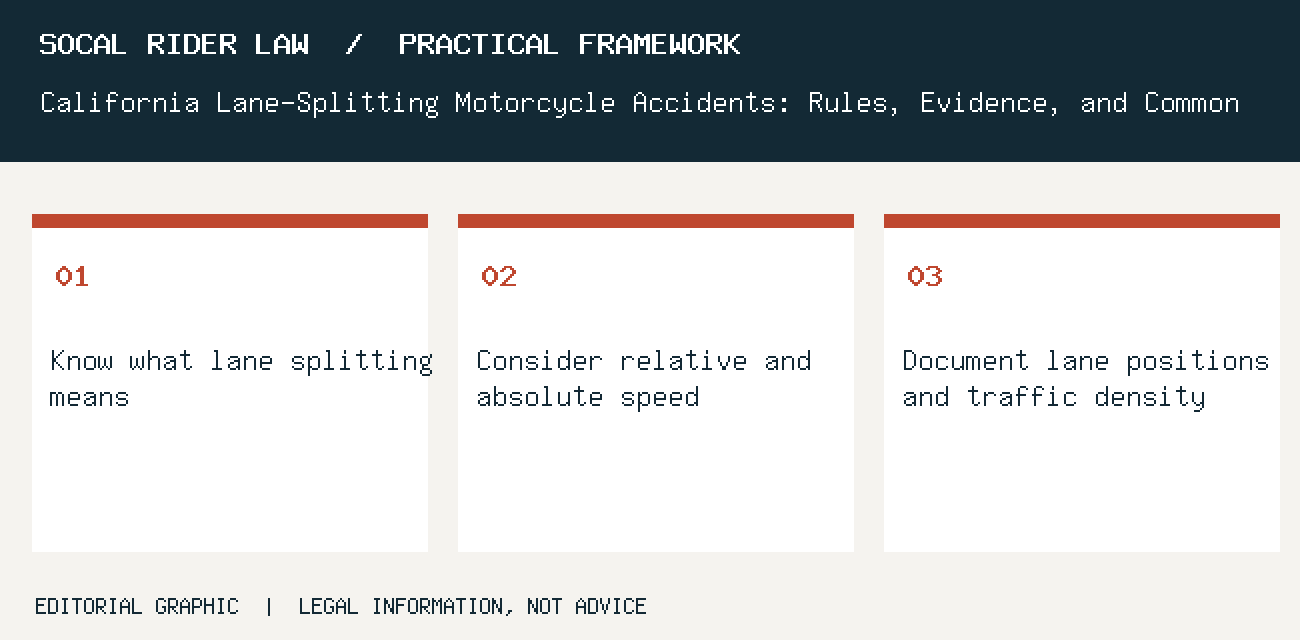
Know what lane splitting means
California law recognizes motorcycles traveling between rows of stopped or moving vehicles; ordinary lane changes and shoulder use present different issues. Describe the observed event before explaining what you think caused it. Where available, identify the source, date and person involved. A reliable chronology is more valuable than an emphatic conclusion that overlooks the surrounding evidence.
Describe the rider’s path, adjacent lanes and traffic conditions before assuming a particular legal label applies. Evidence is most useful when a reader can reconstruct when it was created and what it actually depicts. Save original photographs and recordings separately from annotated presentation copies. If a detail is uncertain, say so rather than attempting to make the sequence appear cleaner than the available evidence supports.
A motorcycle moving between two lines of slowly moving cars may fit the common definition of lane splitting. Ask which source supports this part of the timeline and what might explain the same event differently. A careful record should preserve the original material and identify uncertainty rather than hiding it.
Do not confuse lawful lane splitting with a blanket immunity from ordinary safety obligations. Before taking a difficult-to-reverse action, review the relevant record and consult an appropriate professional. Document who will follow up, what information is missing and whether a legal or insurance deadline may require prompt attention.
Consider relative and absolute speed
CHP safety guidance warns that higher speeds and larger speed differences increase danger during lane splitting. Separate records that document an event from interpretations of legal responsibility. A photograph, witness statement or policy letter may support one part of the account without proving everything. That distinction makes case review more precise.
Record estimates cautiously and preserve any objective measurements or video that may clarify movement. Health and immediate safety are not interchangeable with legal strategy. Clinicians and emergency responders address medical concerns, and qualified legal counsel can assess possible claims, deadlines and evidence needs. Keep those roles distinct even when a serious collision makes many decisions feel urgent.
A rider passing stopped traffic at one speed presents different factual questions from passing fast-moving vehicles.
Do not infer exact speed from damage alone or from an emotional eyewitness description.
Document lane positions and traffic density
Lane width, road curves, vehicle spacing and congestion can affect available movement and sight lines. Focus on what could be verified. Is there an original recording, a dated report, a clinical record or a financial statement? If the answer is no, identify the missing material and consider whether it can be lawfully requested.
Note lane count, position of adjacent vehicles, divider markings and whether traffic was stopped or moving. Insurance communications can contain policy numbers, adjuster references, estimates and requests for information. Maintain a dated communication log and retain the original letters, forms and attachments. That record can help a reviewer find exactly what was requested and when.
A mirror collision between adjacent vehicles may have occurred during a lane change rather than steady travel.
Do not treat a simplified illustration as a scale reconstruction of the incident.
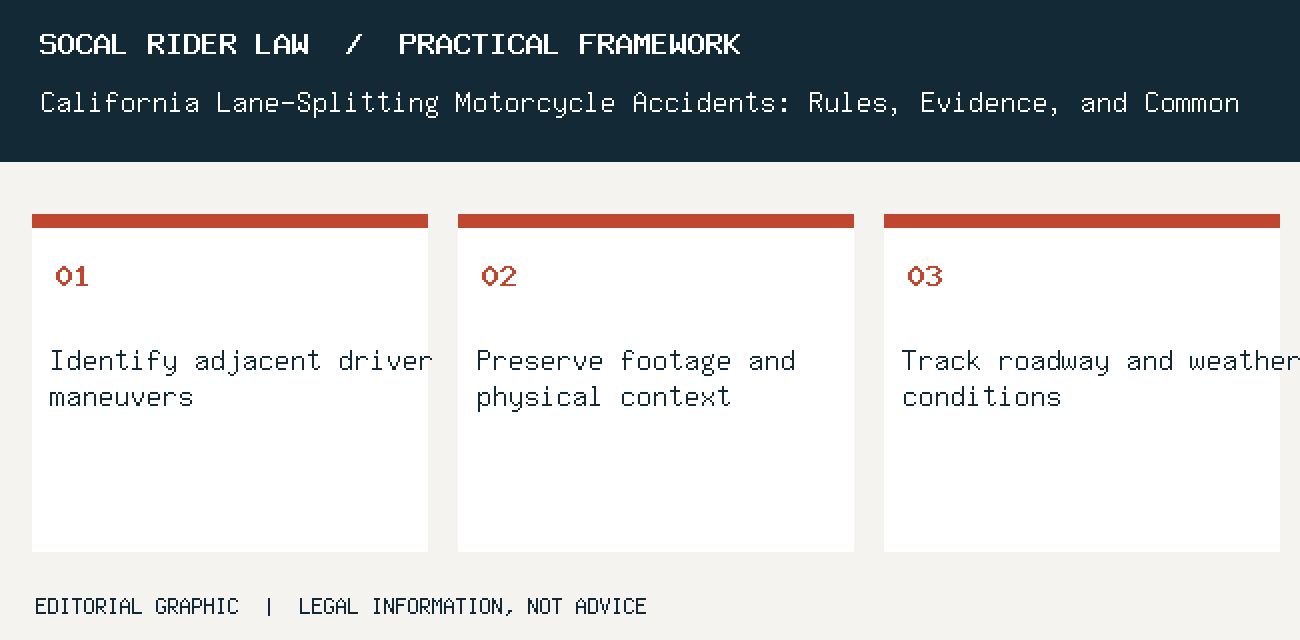
Identify adjacent driver maneuvers
A car may change lanes, drift, open a door or enter traffic while a motorcycle travels nearby. Keep decisions proportionate to the information available. Some matters require immediate attention, but a final release, formal allegation or other irreversible action deserves case-specific review. Preserve uncertainties rather than presenting them as settled facts.
Preserve turn signal observations, video, witness statements and relevant vehicle damage. The scene may change quickly as vehicles are removed, traffic resumes and weather shifts. Reliable photographs and notes can preserve context, but they should not put anyone in danger. Describe the source of every image and avoid assigning a conclusion the image alone cannot establish.
A sudden lane change can be relevant even if the driver later says no motorcycle was visible.
Do not assume every change of lane establishes fault without the surrounding sequence.
Preserve footage and physical context
Helmet cameras and nearby vehicle cameras can show relative movement but may distort perceived speed or distance.
Save original recordings, note camera mounting and preserve the approach before and after the event. Often the facts that matter most are not the ones initially debated. A disputed speed estimate, camera clock or lane position may later be clarified by an independent record. Maintain competing versions when they exist and identify what additional information could help evaluate them.
A wide-angle camera may make adjacent vehicles appear farther away than they were.
Do not make editing the only version of a clip used in a claim discussion.
Track roadway and weather conditions
Rain, debris, construction work, lighting and glare can affect traction and visibility. That distinction makes case review more precise.
Record weather, time of day, road surface, markings, construction signs and photographs. Documentation of costs should separate amounts billed, amounts paid, estimated future costs and balances in dispute. Attach the underlying invoice or statement to the summary. Accuracy matters more than inflating the size of the file with unverified totals.
A narrow work-zone lane may change the available space compared with ordinary freeway conditions.
Do not attribute the collision to weather without evidence connecting conditions to the event.
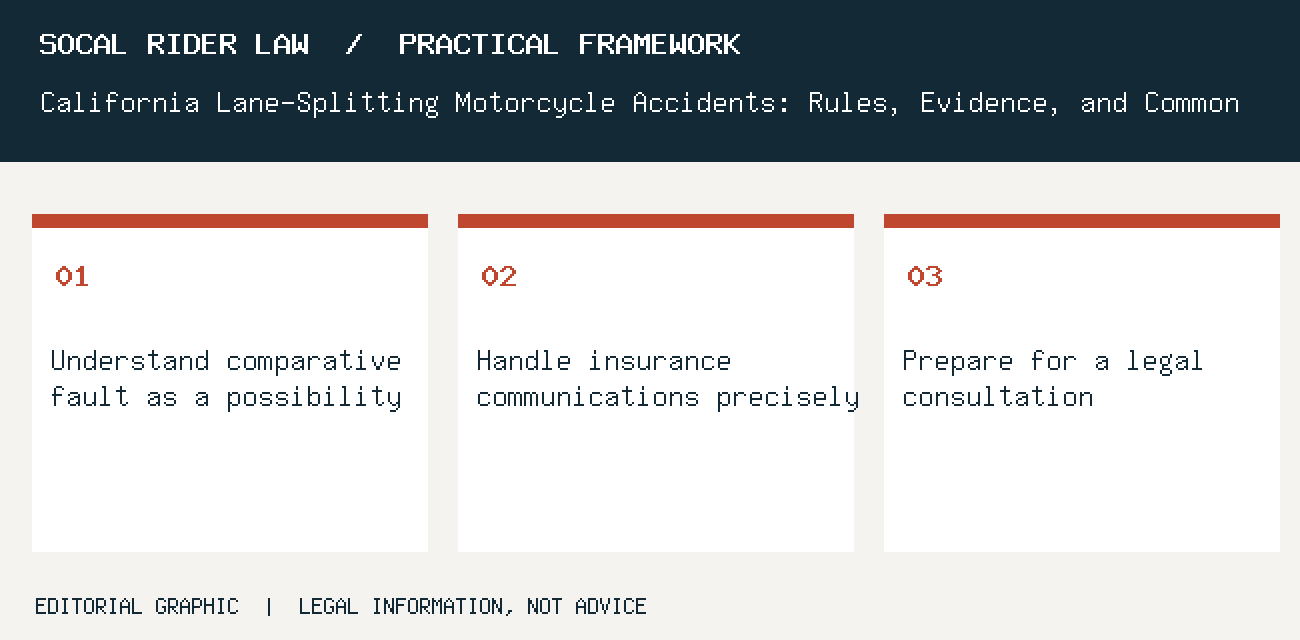
Understand comparative fault as a possibility
California injury cases can involve assessment of conduct by more than one person; labels alone do not resolve allocation. Focus on what could be verified.
Gather facts bearing on both rider and driver behavior without deciding the final legal percentage yourself. An independent observer may have seen only part of the event. Preserve contact information and the witness’s own account without pressuring the person toward a preferred statement. A report from one angle can be important yet incomplete.
A driver who failed to check a mirror and a rider moving unsafely may both raise questions requiring review.
Do not accept a proposed blame percentage merely because an adjuster states it confidently.
Handle insurance communications precisely
Insurers may ask whether the rider was splitting lanes and request recorded details before full evidence is available. Keep decisions proportionate to the information available.
Record the questions asked, provide accurate information and review statement or release requests appropriately. California roadway rules and insurance requirements provide context, not an automatic outcome for a specific accident. A rider’s conduct, another driver’s actions, the physical scene and applicable defenses all require review. Avoid generic statements that any single rule decides fault.
A claimant may know they were between lanes but not accurately recall the speed of every nearby vehicle.
Do not speculate about measurements or let a recording replace a full factual investigation.
Prepare for a legal consultation
A useful review focuses on the exact positions, video sources, injuries, insurance policies and looming deadlines.
Bring a timeline, available camera files, photographs, report reference and details of insurer contact. A useful consultation packet should be concise enough to navigate but complete enough to reveal uncertainties. Include a timeline, source index, key communications, major bills or estimates and an unanswered-question list. Early, organized review can identify next steps without promising recovery.
The attorney can identify missing evidence and discuss possible next steps without promising a case value.
Do not assume that legality alone establishes the outcome of a negligence or insurance analysis.
Practical nine-point checklist
- Know what lane splitting means: Describe the rider’s path, adjacent lanes and traffic conditions before assuming a particular legal label applies.
- Consider relative and absolute speed: Record estimates cautiously and preserve any objective measurements or video that may clarify movement.
- Document lane positions and traffic density: Note lane count, position of adjacent vehicles, divider markings and whether traffic was stopped or moving.
- Identify adjacent driver maneuvers: Preserve turn signal observations, video, witness statements and relevant vehicle damage.
- Preserve footage and physical context: Save original recordings, note camera mounting and preserve the approach before and after the event.
- Track roadway and weather conditions: Record weather, time of day, road surface, markings, construction signs and photographs.
- Understand comparative fault as a possibility: Gather facts bearing on both rider and driver behavior without deciding the final legal percentage yourself.
- Handle insurance communications precisely: Record the questions asked, provide accurate information and review statement or release requests appropriately.
- Prepare for a legal consultation: Bring a timeline, available camera files, photographs, report reference and details of insurer contact.
Frequently asked questions
Is lane splitting legal in California?
Yes, California authorities recognize legal lane splitting; safety, prudence and the particular facts still matter. The specific facts and official documents should be evaluated before any legal or coverage conclusion.
Does lane splitting automatically make a rider at fault?
No. There is no automatic fault outcome simply from the label.
What is comparative fault?
It is a framework for examining the conduct of multiple participants; legal application depends on case-specific facts.
What if the car changed lanes without signaling?
Preserve relevant evidence and evaluate all movements; one reported violation does not substitute for a full review.
Explore related rider and injury resources
- Motorcycle injury and accident representation
- Motorcycle evidence and insurance guidance
- Additional injury and legal resources
- Request a case review
Official resource: California CHP motorcycle safety and lane splitting.
General information, not legal or medical advice. No attorney-client relationship is created by reading this page, and no outcome is guaranteed. Timelines and remedies depend on specific facts and law.
Questions after a motorcycle crash?
Coverage, treatment and responsibility can be complicated. Request a case review based on your actual accident, insurance documents and concerns.