
Motorcycle Accident Settlement Offers: A Careful Checklist Before Signing a Release
Motorcycle Accident Settlement Offers: A Careful Checklist Before Signing a Release: a practical guide for riders and families.
A settlement offer may arrive while medical appointments, repair discussions or insurance questions are still underway. Receiving an offer does not establish that it fairly reflects the claim, and rejecting one does not guarantee a better result later. The key is to understand what the proposed payment covers, which parties are being released, which facts remain unresolved and whether deadlines still require action. This guide offers a practical document checklist for evaluating the proposal with appropriate legal advice.
Important: This guide is educational. In an emergency, follow medical and public-safety directions. Legal rights and coverage depend on the full evidence, policy documents, jurisdiction and timing.
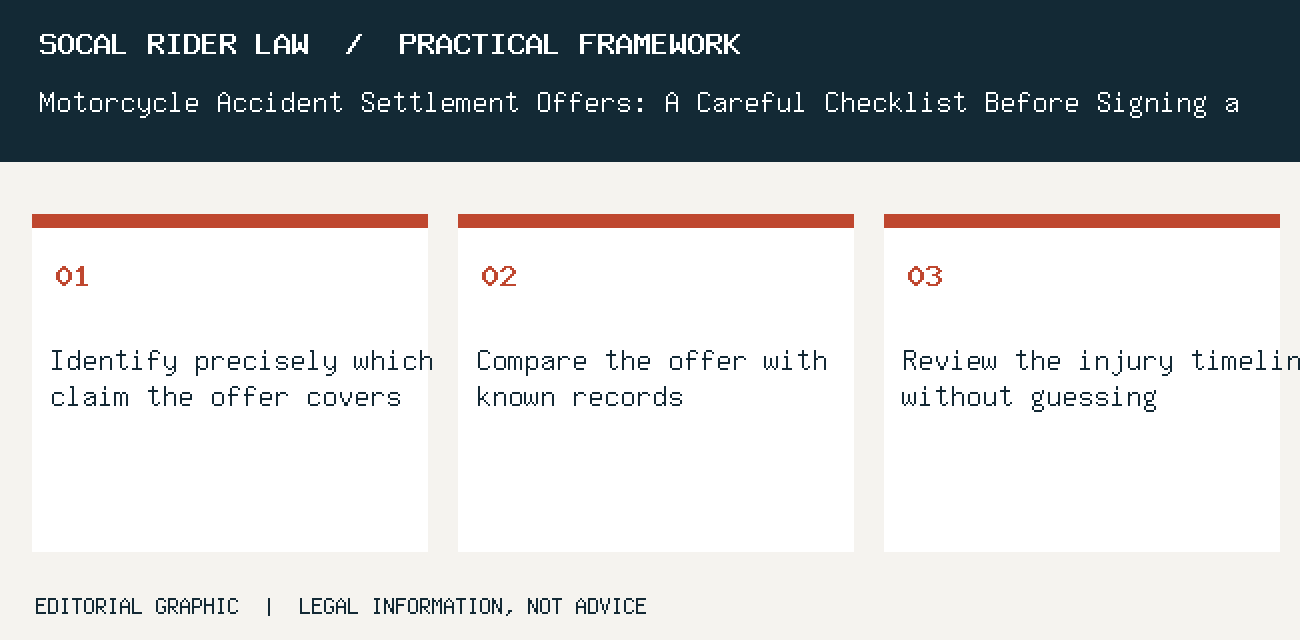
Identify precisely which claim the offer covers
An insurance communication may concern vehicle repairs, bodily injury, a particular insured person or several claims together. Describe the observed event before explaining what you think caused it. Where available, identify the source, date and person involved. A reliable chronology is more valuable than an emphatic conclusion that overlooks the surrounding evidence.
Read the offer letter and accompanying release, noting the covered event, parties, dates and claims. Evidence is most useful when a reader can reconstruct when it was created and what it actually depicts. Save original photographs and recordings separately from annotated presentation copies. If a detail is uncertain, say so rather than attempting to make the sequence appear cleaner than the available evidence supports.
A property-damage payment can appear separate from a bodily-injury proposal, but the release wording must be checked. Ask which source supports this part of the timeline and what might explain the same event differently. A careful record should preserve the original material and identify uncertainty rather than hiding it.
Do not assume a familiar-looking form always releases only the item mentioned in the covering email. Before taking a difficult-to-reverse action, review the relevant record and consult an appropriate professional. Document who will follow up, what information is missing and whether a legal or insurance deadline may require prompt attention.
Compare the offer with known records
A useful assessment separates verified costs, disputed amounts and uncertain future issues. Separate records that document an event from interpretations of legal responsibility. A photograph, witness statement or policy letter may support one part of the account without proving everything. That distinction makes case review more precise.
Reconcile treatment invoices, insurer payments, wage documents, property estimates and out-of-pocket records. Health and immediate safety are not interchangeable with legal strategy. Clinicians and emergency responders address medical concerns, and qualified legal counsel can assess possible claims, deadlines and evidence needs. Keep those roles distinct even when a serious collision makes many decisions feel urgent.
A hospital statement may still be pending insurance adjustment when the offer is made.
Do not rely on a rough total that double-counts charges and payments.
Review the injury timeline without guessing
Treatment status, clinician advice and documented limitations may affect the information available for evaluation. Focus on what could be verified. Is there an original recording, a dated report, a clinical record or a financial statement? If the answer is no, identify the missing material and consider whether it can be lawfully requested.
Organize appointments, records, recommendations, work restrictions and current questions for professionals. Insurance communications can contain policy numbers, adjuster references, estimates and requests for information. Maintain a dated communication log and retain the original letters, forms and attachments. That record can help a reviewer find exactly what was requested and when.
A rider may still be awaiting a specialist interpretation when a release is offered.
Do not predict medical recovery from an internet checklist or alter clinical decisions for settlement strategy.
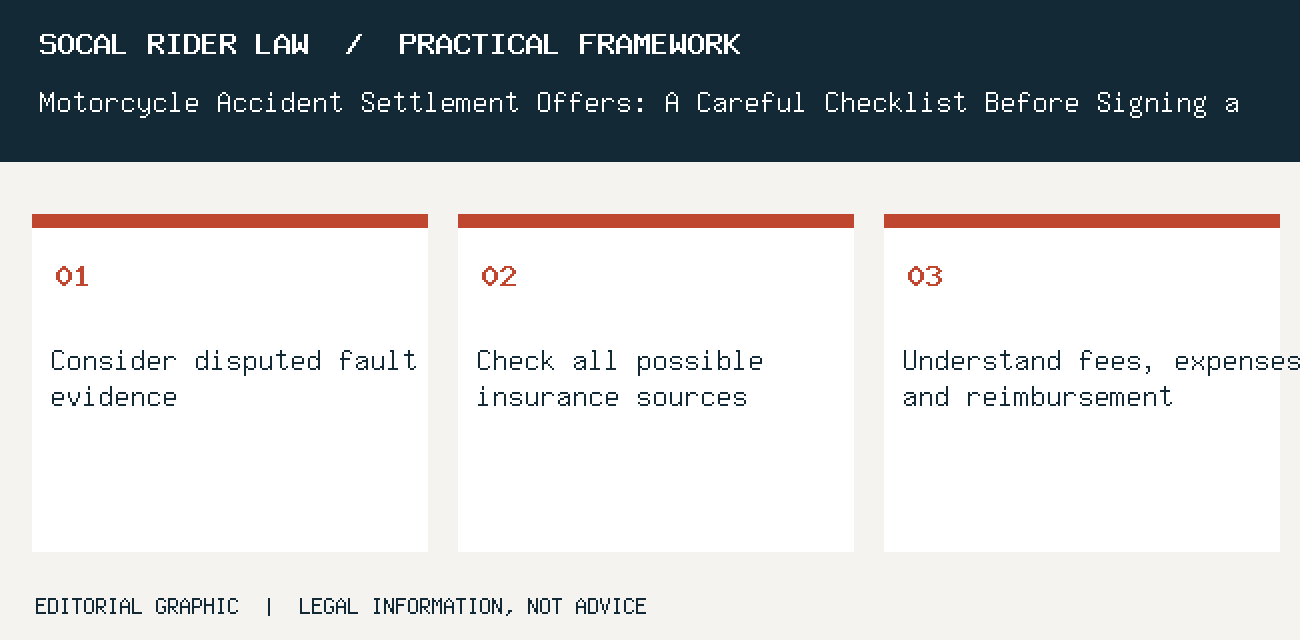
Consider disputed fault evidence
An insurer may discount an offer based on a version of the crash that is not yet fully supported. Keep decisions proportionate to the information available. Some matters require immediate attention, but a final release, formal allegation or other irreversible action deserves case-specific review. Preserve uncertainties rather than presenting them as settled facts.
Identify scene photos, original video, witnesses, incident reports and factual disagreements. The scene may change quickly as vehicles are removed, traffic resumes and weather shifts. Reliable photographs and notes can preserve context, but they should not put anyone in danger. Describe the source of every image and avoid assigning a conclusion the image alone cannot establish.
A driver and rider may give conflicting accounts of an intersection light sequence.
Do not accept or reject a fault percentage without understanding its factual basis.
Check all possible insurance sources
The final financial picture may depend on other policies, available limits and coverage conditions.
Collect declarations, claim correspondence and the operative insurance policy language. Often the facts that matter most are not the ones initially debated. A disputed speed estimate, camera clock or lane position may later be clarified by an independent record. Maintain competing versions when they exist and identify what additional information could help evaluate them.
A third-party offer may interact with underinsured motorist questions under another policy.
Do not assume that the largest available policy limit is the same as the value of a claim.
Understand fees, expenses and reimbursement
The gross settlement figure may differ from funds available after applicable obligations are resolved. That distinction makes case review more precise.
Request a transparent explanation of proposed fees, expenses and any claimed medical or benefit reimbursements. Documentation of costs should separate amounts billed, amounts paid, estimated future costs and balances in dispute. Attach the underlying invoice or statement to the summary. Accuracy matters more than inflating the size of the file with unverified totals.
A large written offer may need to account for outstanding provider balances and contractual repayment terms.
Do not assume every lien or reimbursement demand has already been verified.
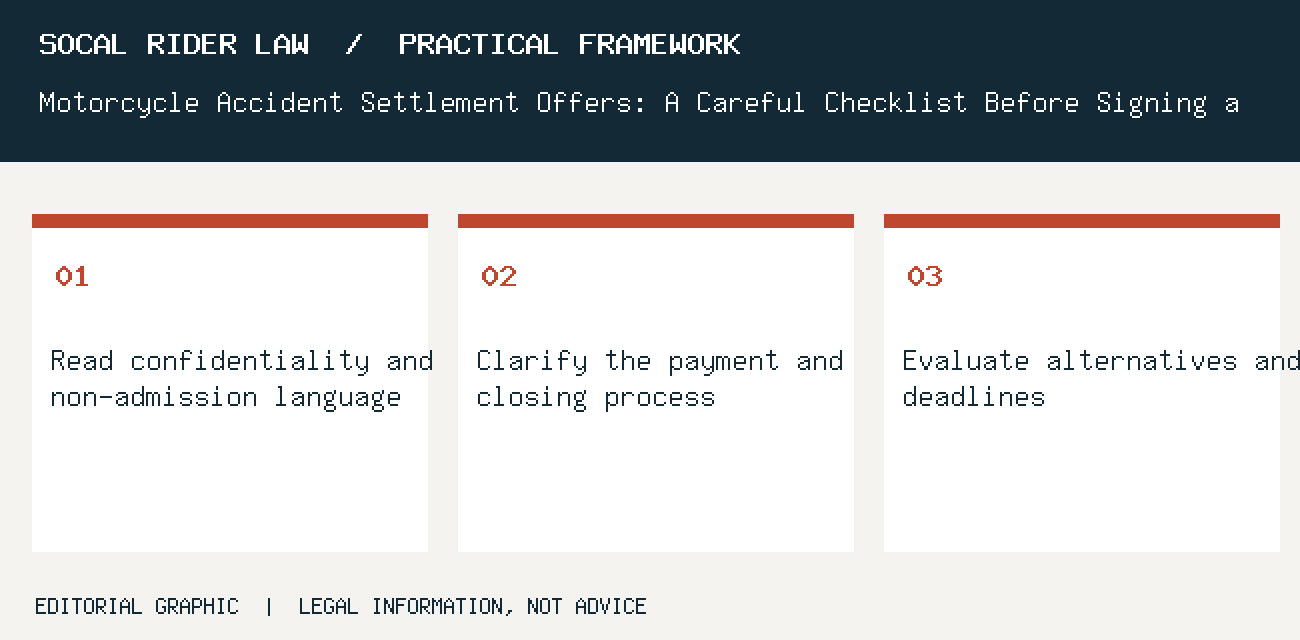
Read confidentiality and non-admission language
Settlement documents can include confidentiality, non-disparagement, cooperation or other continuing provisions. Focus on what could be verified.
Mark every obligation and ask how it would operate after payment. An independent observer may have seen only part of the event. Preserve contact information and the witness’s own account without pressuring the person toward a preferred statement. A report from one angle can be important yet incomplete.
A release might cover unknown claims or related parties beyond the obvious insurer.
Do not sign merely because the payment amount appears in bold on the first page.
Clarify the payment and closing process
A settlement agreement should address signatories, timing, payment delivery and completion requirements. Keep decisions proportionate to the information available.
Identify who signs, when funds are due, how releases are exchanged and what happens if an obligation is missed. California roadway rules and insurance requirements provide context, not an automatic outcome for a specific accident. A rider’s conduct, another driver’s actions, the physical scene and applicable defenses all require review. Avoid generic statements that any single rule decides fault.
A claimant may need confirmation that a release is received before an insurer issues payment.
Do not treat an unsigned draft as a completed transaction.
Evaluate alternatives and deadlines
A settlement decision weighs uncertainty, cost, evidence, practical needs and the risks of continued dispute.
Discuss options and any applicable filing or policy deadlines with qualified counsel promptly. A useful consultation packet should be concise enough to navigate but complete enough to reveal uncertainties. Include a timeline, source index, key communications, major bills or estimates and an unanswered-question list. Early, organized review can identify next steps without promising recovery.
Negotiation may continue, but that does not necessarily suspend an independent legal deadline.
Do not wait for a response to an offer if another deadline requires action.
Practical nine-point checklist
- Identify precisely which claim the offer covers: Read the offer letter and accompanying release, noting the covered event, parties, dates and claims.
- Compare the offer with known records: Reconcile treatment invoices, insurer payments, wage documents, property estimates and out-of-pocket records.
- Review the injury timeline without guessing: Organize appointments, records, recommendations, work restrictions and current questions for professionals.
- Consider disputed fault evidence: Identify scene photos, original video, witnesses, incident reports and factual disagreements.
- Check all possible insurance sources: Collect declarations, claim correspondence and the operative insurance policy language.
- Understand fees, expenses and reimbursement: Request a transparent explanation of proposed fees, expenses and any claimed medical or benefit reimbursements.
- Read confidentiality and non-admission language: Mark every obligation and ask how it would operate after payment.
- Clarify the payment and closing process: Identify who signs, when funds are due, how releases are exchanged and what happens if an obligation is missed.
- Evaluate alternatives and deadlines: Discuss options and any applicable filing or policy deadlines with qualified counsel promptly.

Frequently asked questions
Must I accept the insurer’s first offer?
No general rule requires accepting the first offer; circumstances and deadlines need review. The specific facts and official documents should be evaluated before any legal or coverage conclusion.
Can I settle just property damage?
Sometimes distinct claims can be handled separately, but the actual release language is decisive.
Does an insurer’s stated percentage of fault settle the legal issue?
No. It is a position that should be evaluated against the facts and governing law.
What if I sign and later discover new expenses?
A broad release may have significant consequences. Review its scope before signing.
Explore related rider and injury resources
- Motorcycle injury and accident representation
- Motorcycle evidence and insurance guidance
- Additional injury and legal resources
- Request a case review
Official resource: California Courts: civil lawsuit deadlines.
General information, not legal or medical advice. No attorney-client relationship is created by reading this page, and no outcome is guaranteed. Timelines and remedies depend on specific facts and law.
Questions after a motorcycle crash?
Coverage, treatment and responsibility can be complicated. Request a case review based on your actual accident, insurance documents and concerns.